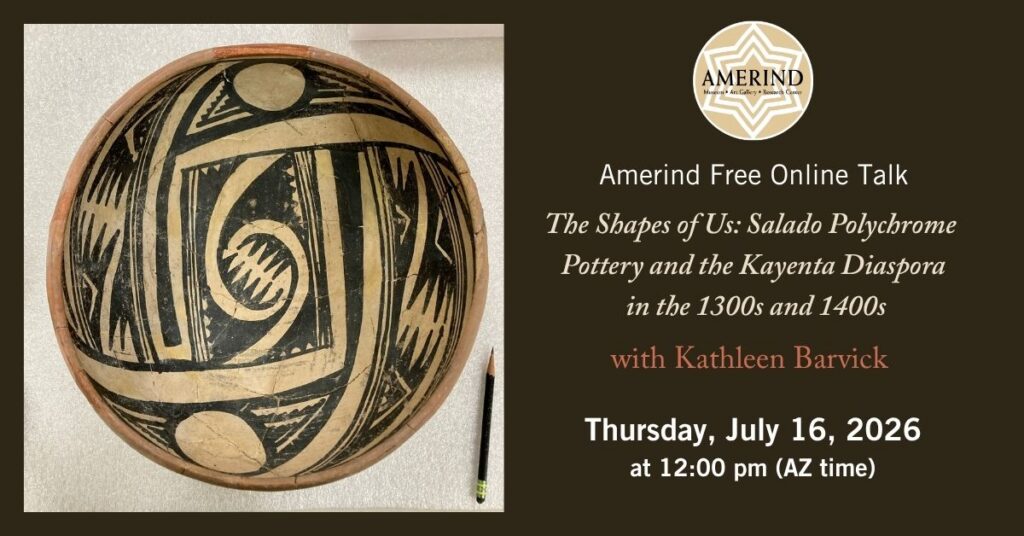
Free Online Talk: The Shapes of Us: Salado Polychrome Pottery and the Kayenta Diaspora in the 1300s and 1400s,” with Kathleen Barvick.

Amerind Free Online Talk
Thursday, July 16, 2026
12:00 pm (AZ time)
To register, visit: https://bit.ly/Amerindonline07162026Barvick

Join us on Thursday, July 16, 2026 at 12:00 pm (AZ time) for an online talk,The Shapes of Us: Salado Polychrome Pottery and the Kayenta Diaspora in the 1300s and 1400s” with PhD candidate Kathleen Barvick.

In the late 1200s, a massive drought hit the Southwest, causing political instability and sparking a massive migration as people left the Four Corners area and migrated south to settle along the rivers, which changed to social and political organization of the Southwest forever. One group of people, from the Kayenta region of northeastern Arizona, settled across a wide area of central and southern Arizona and western New Mexico, sometimes integrating into local settlements, sometimes setting up their own enclaves away from existing settlements. Dr. Barvick’s research focuses on Salado polychrome, a specific type of pottery that arose among these Kayenta immigrant communities and spread across Arizona and New Mexico. By looking at Salado polychrome pots across the Southwest, and specifically at the variation in their shapes, she investigates how the Kayenta immigrant diaspora shared technological practices regarding pottery creation across far-flung communities in the 1300s and 1400s, how the use of Salado polychrome spread, and how Kayenta immigrants negotiated their identities as Kayenta people and as immigrants in their new homes.

Dr. Kate Barvick is an archaeologist who studies pottery, migration, and community networks in the US Southwest. She grew up in Massachusetts and received a BA in Anthropology and Linguistics from the University of Massachusetts Amherst in 2018. Her archaeology experience in Massachusetts focused on 18th- and 19th-century historic house sites, with a special emphasis on the Revolutionary War era. Her research in the Southwest is both older than that (she spent several summers in northern New Mexico near Taos, on a collaborative community project with Picuris Pueblo) and more recent (she spent several years researching the history of baseball and its connection to labor movements in the 20th century in Bisbee, AZ). She brings from this background a passion for public archaeology, community engagement, and the bridging of the past and the present. She currently lives in Tucson, recently defended her PhD at the University of Arizona, and is the Amerind Emerging Scholar-in-Residence in Summer 2026.

If you are unsure if you can watch live, register using an email and the recording of the talk will be sent to you following the program.

We hope you will join us!

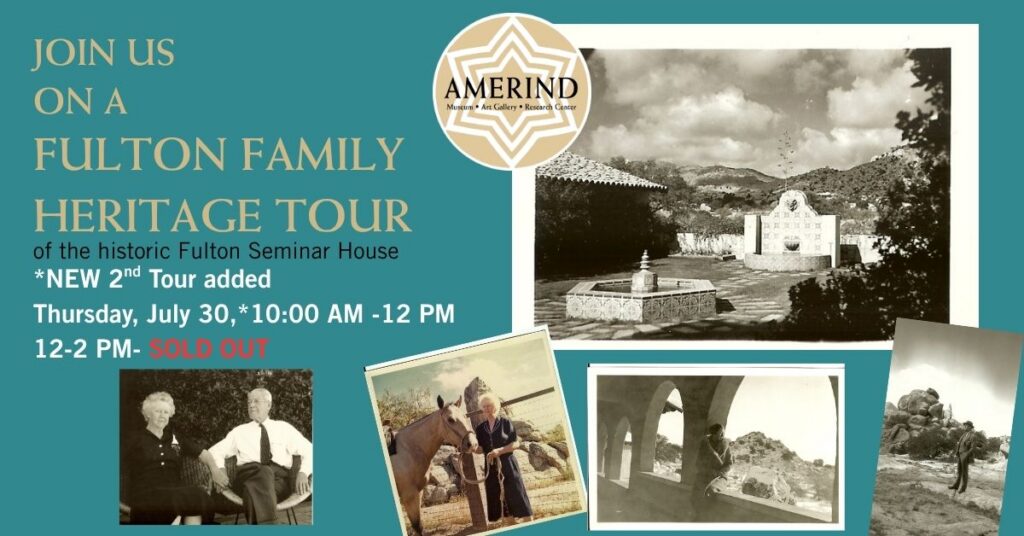
Fulton Family Heritage Tour

Fulton Family Heritage Tour
Thursday, July 30, 2026
12- 2 PM
$20 for Seniors/Students, $22 for Adults, Free to Members
Price includes admission to the Museum and Art Galleries.
Limited to 12 people

Amerind Fulton Family Heritage Tour with Willie Adams:

Have you ever wondered more about Amerind’s founding family? Or want to peek at the historic home behind the museum and art galleries? Now is your opportunity.

You are invited to take an insider’s tour of the historic Fulton Seminar House, where heritage meets elegance. The tour will be led by Willie Adams, great-grandson of Amerind founder William Shirley Fulton, who provides unique insights into Amerind’s history, peppered with a few entertaining family tales! Experience Amerind in an exclusive, intimate setting with a behind–the–scenes tour of the Fulton Seminar House.

Tours are Free to Members, $20. for seniors and students, $22 for adults

Price includes admission to the Museum and Art Galleries.

Tour is limited to 12 people

Don’t miss out on this exclusive opportunity!

Reserve your spot today!

To purchase your ticket or learn more details, go to:  https://bit.ly/heritagetour2026

Members call Maggie at 520-686-1336 or email [email protected] to reserve your spot.

Amerind Members -Fulton Family Heritage Luncheon & Tour

You’re invited to the Fulton Family Heritage Luncheon & Tour

Thursday, June 25, 2026
10:30 AM – 1:00 PM
Members-Only: $35 per person

Reserve your ticket here: Eventbrite

You’re invited to the Fulton Family Heritage Luncheon & Tour

Where heritage meets elegance, an exclusive members-only tour of the historic Fulton Seminar House

Where heritage meets elegance, join us for an insider members-only tour of the historic Fulton Seminar House with a delightful luncheon included.

Photo: front left, Amerind archaeologist Charles Di Peso seated next to Mrs. Rose Hayden-Fulton with Amerind founder William Shirley Fulton middle right.]

Amerind Members-Fulton Family Heritage Luncheon!

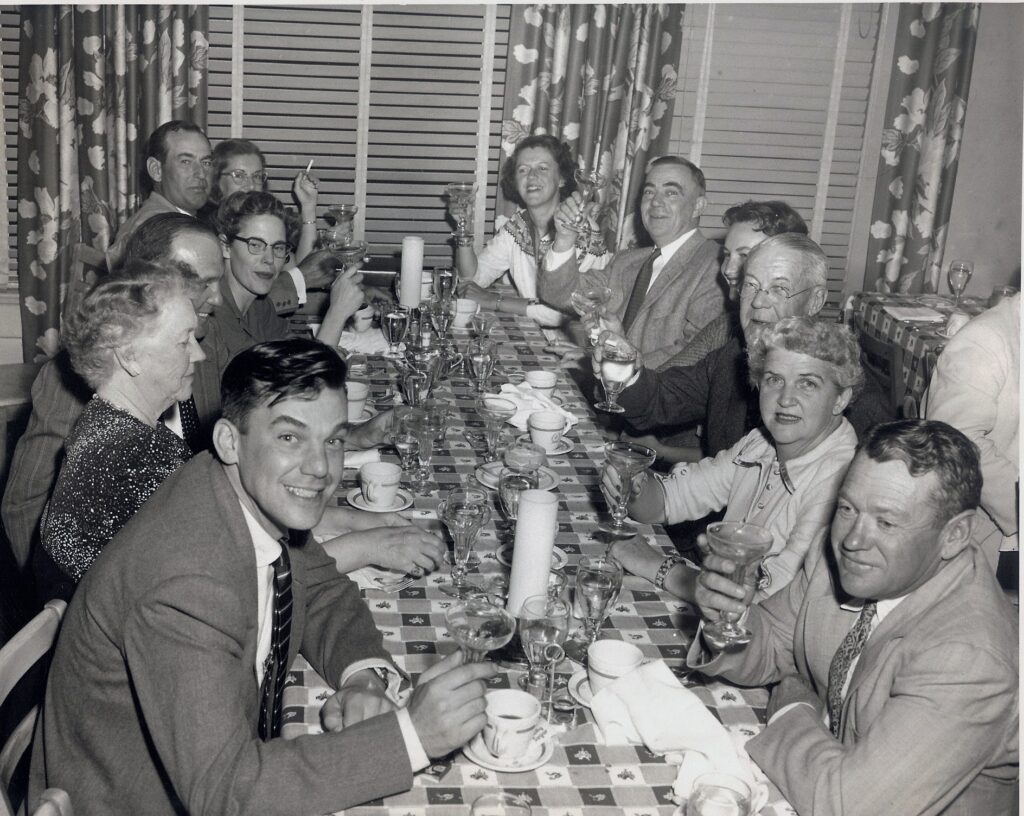
Please join us for the ultimate experience with Amerind’s history, founding family, and our talented Guest Services team. Members will enjoy a warm welcome to the Fulton Seminar House followed by a personal Tour with family stories led by our founders’ great-grandson, Willlie Adams. Your Tour will be followed by an elegant lunch together-with dessert-in the formal dining room. After lunch enjoy the Museum, Art Gallery, and Museum Store and see what’s new. Your membership includes a 10% discount on all shop purchases.

Fulton Family Heritage Luncheon

Thursday, June 25, 2026

10:30 AM – 1:00 PM

Members-Only price: $35 per person

With seating limited to 12 guests, reserve your spot today!

Purchase your tickets by following the button below. Questions or any dietary restrictions, please call Maggie Ohnesorgen at 520-686-1336 or email [email protected] to reserve.


Not a Member? Consider joining the supportive Amerind community for access to this exclusive opportunity by visiting our membership page here. Annual memberships start at $50.

If you are not sure about your Membership status, please contact [email protected] or call Kelly Holt at 520-686-6172.


Don’t miss out on this exclusive opportunity!

The Amerind will be at Celebrate the San Pedro at San Pedro House

Join us at the San Pedro House

9800 E. Highway 90 Sierra Vista, AZ.

Saturday, April 25th. 9:00 am – 2:00 pm

Free Event

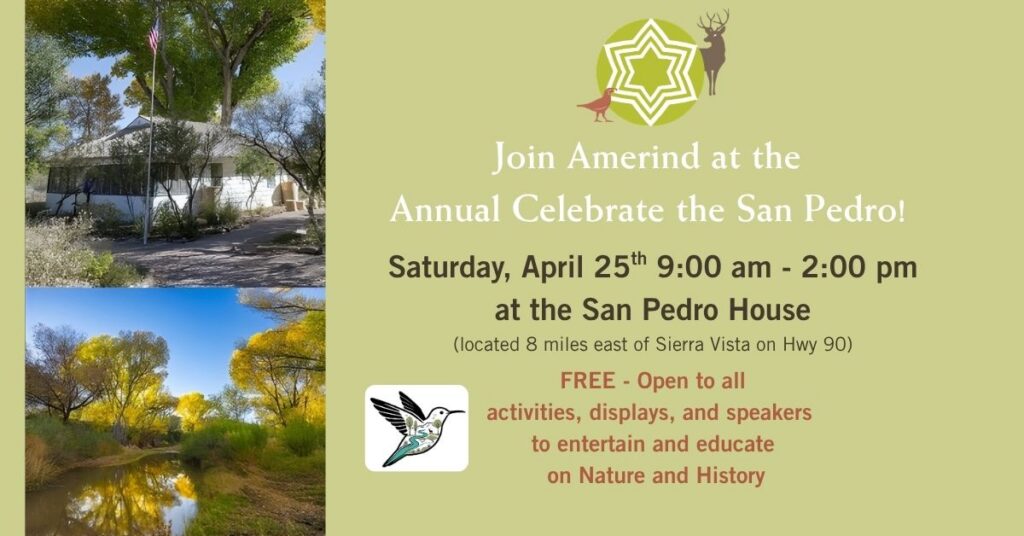
Come out for a fun day celebrating the San Pedro with activities, speakers, booths, and more to entertain and educate on Nature and History of the area.

Join the Amerind on Saturday, April 25th from 9:00 am – 2:00 pm for the annual Celebrate the San Pedro event. This event is FREE and open to all. There will be activities, displays and speakers to entertain and educate about the natural and historical wonders of the San Pedro Riparian Conservation Area, of SPRNCA.

Amerind will be one of many booths where you can come and learn about the Amerind, pick up some free passes, and participate in an all ages, art activity with us. There will also be the annual team bird count competition!

We hope you come out and learn about the natural and cultural history of the area with us. The San Pedro House is located eight miles east of Sierra Vista on Highway 90. 9800 E. Highway 90 Sierra Vista, AZ.

Come celebrate the San Pedro!

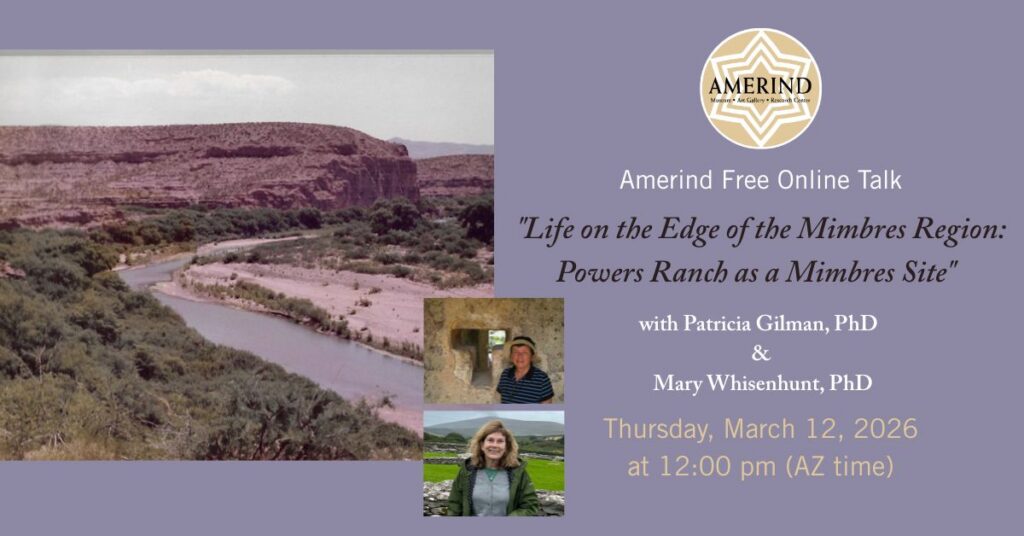
Free Online Talk: “Life on the Edge of the Mimbres Region: Powers Ranch as a Mimbres Site” with Patricia Gilman & Mary Whisenhunt

Free Online Talk
Thursday, March 12, 2026
12:00 pm – 1:00 pm (AZ time)
Life on the Edge of the Mimbres Region: Powers Ranch as a Mimbres Site” with Patricia Gilman, PhD & Mary Whisenhunt, PhD

To register, visit: https://bit.ly/Amerindonline03122026Gilman

Join us on Thursday, March 12, 2026 at 12:00 pm (AZ time) for an online talk, “Life on the Edge of the Mimbres Region: Powers Ranch as a Mimbres Site”, with Patricia Gilman, PhD and Mary Whisenhunt, PhD.

When people think of Mimbres archaeology, they picture beautiful black-on-white pottery with paintings of people and animals and large pueblo sites in the Mimbres Valley of southwestern New Mexico.  However, there were Mimbres sites beyond the Mimbres Valley, but they were different from those in the valley.  We explore what it meant to be Mimbres at the Powers Ranch site, a small settlement at the western edge of the Mimbres region. We conclude that the people at Powers Ranch were quintessentially Mimbres and were more closely affiliated with Mimbres settlements on the Gila River drainage in southeast Arizona and New Mexico than with those living in the Mimbres Valley core area.

Mary Whisenhunt received her anthropology doctorate in 2020, conducting her field work in southeast Arizona. Her research focused on the social resilience of precontact Indigenous people on the western boundary of the Mimbres region.

Patricia Gilman has done archaeological research in the Mimbres region for more than 50 years, retiring from the Department of Anthropology at the University of Oklahoma. One of her research foci has been Mimbres beyond the Mimbres Valley.

We hope you will join us!

If you can’t join us to watch live on March 12th, register using an email and the recorded talk will be sent to you after the talk, to watch at your leisure.


Free Online Talk “Our Elder Brother Dwells There: How I’itoi Ki Moved from Mountain Peak to Basket Design.” with David Martinez, PhD.

Photo: Early 20th Century O’odham Basket with “Man in the Maze” design, 13 1/4″ dia., Amerind permanent collection

Amerind Free Online Talk

Thursday, February 12, 2026

12:00 pm (AZ time)

Our Elder Brother Dwells There: How I’itoi Ki Moved from Mountain Peak to Basket Design.” with David Martinez, PhD. (Akimel O’odham/Hia-Ced O’odham/Mexican)

To register, visit: https://bit.ly/Amerindonline02122026Martinez

Join us on Thursday, February 12, 2026 at 12:00 pm (AZ time) for a free online talk, “Our Elder Brother Dwells There: How I’itoi Ki Moved from Mountain Peak to Basket Design.” with Dr. David Martinez.

“Learn about I’itoi, Elder Brother, who taught O’odham how to live well in their desert homelands. Learn where his home, his kih, is located, according to oral tradition. Most importantly, learn about how the symbol of this home, I’itoi kih, started appearing in O’odham baskets more than a century ago. What does it all mean?”

David Martínez (Akimel O’odham/Hia-ced O’odham/Mexican), Is a Professor of American Indian Studies and Transborder Studies at Arizona State University. He is the author of the forthcoming The Maze of History: Komal Hok, O’odham Teachings, and an Earth-Based Sense of Time (University of New Mexico Press, April 2026).

Martínez is also the author of Dakota Philosopher: Charles Eastman and American Indian Thought (Minnesota Historical Society Press, 2009), Life of the Indigenous Mind: Vine Deloria Jr and the Birth of the Red Power Movement (University of Nebraska Press, 2019), My Heart Is Bound Up With Them: How Carlos Montezuma Became the Voice of a Generation (University of Arizona Press, 2023), and editor of The American Indian Intellectual Tradition: An Anthology of Writings from 1772 to 1972 (Cornell University Press, 2011).

Dr. Martínez is also the director and founder of the Institute for Transborder Indigenous Nations (ITIN), which is housed in the School of Transborder Studies at ASU, where it focuses on Indigenous nations impacted by the US-Mexico Border.

Interested but unsure if you will be able to join us live? Register using an email and the recording of the talk will be sent later that evening to all registrants.

We hope you will join us for this fascinating talk.


Amerind Free Online Talk: O’Odham Pottery: Prehistoric, Historic, and Contemporary Native American Ceramic Production in the Phoenix Basin of Southern Arizona with Linda Morgan, M.A., (Akimel O’Odham, Dinè), and Katrina Soke, (Akimel O’Odham)

Amerind Free Online Talk

O’Odham Pottery: Prehistoric, Historic, and Contemporary Native American Ceramic Production in the Phoenix Basin of Southern Arizona

with Linda Morgan, M.A., (Akimel O’Odham, Dinè), and Katrina Soke, (Akimel O’Odham)

Thursday, October 30, 2025

12:00 pm – 1:00 pm (AZ time)

Within the last three decades, Native communities in the United States have taken on the management of their own archaeological resources, including the establishment of Cultural Resource Management Departments.  These developments have resulted in increased interactions between archaeologists and Native people, which has led to a better understanding of indigenous material culture, especially more recent remains, which for obvious reasons are more concentrated within extant Native American reservations, such as the Gila River Indian Community (GRIC).  This presentation discusses research by the GRIC Cultural Resource Management Program (GRIC-CRMP), focusing on their recent contributions to the indigenous ceramic analysis process.

Linda Morgan, M.A., (Akimel O’Odham, Dinè), is from Blackwater, AZ. and a member of the Gila River Indian Community (GRIC). She has worked for the GRIC’s Cultural Resource Management Program (CRMP) since 1994 and is currently Director of the CRMP. She has been a ceramic analyst for the department since 1994 specializing in the analysis of prehistoric Hohokam and Historic O’Odham indigenous ceramics. She has a BA in Anthropology and a Master’s Degree in Museum Studies from Arizona State University.

Katrina Soke, (Akimel O’Odham), is from Gila Crossing, AZ. She is an enrolled member of the Gila River Indian Community (GRIC), where she was born and raised. She has worked for the GRIC’s Cultural Resource Management Program (CRMP) since 2016 as a Laboratory Technician.  She is a ceramic analyst with extensive experience studying prehistoric and historic Indigenous ceramics.

Please note our day and time change- Hoping you can grab your lunch and join us for lunchtime learning at the Amerind!

If you are not able to join us live, register using an email and the recording of the talk will be sent to you later that evening and available to watch on our You Tube Channel: Amerind Foundation at your leisure.


Amerind Free Online Talk: Indians and Energy Transition: Green New Deal to ‘Drill, Baby, Drill!’ with Scholar Andrew Curley, PhD (Diné).

Free Online Talk

Saturday, July 26, 2025 

11:00 am (AZ time)

Indians and Energy Transition: Green New Deal to ‘Drill, Baby, Drill!’ with Scholar Andrew Curley, PhD (Diné).
To register, visit: https://bit.ly/Amerindonline07262025Curley

Please take this opportunity to join us on Saturday, July 26, 2025 at 11:00 am (AZ time) for an online talk Indians and Energy Transition: Green New Deal to ‘Drill, Baby, Drill!’ with scholar Andrew Curley, PhD (Diné) as he discusses his research on the implications of energy transitions on Indigenous nations.

Energy in the United States is a topic of extreme importance. It is foundational to the U.S. economy, infrastructure, development in local communities, and accelerating processes of climate change. In political rhetoric, energy conversations oscillate between broad ideas of clean energy technology to opening more and more protected spaces for oil and gas drilling. Tribal communities are often caught in the middle of these political movements. Native leaders, planners, and workers must anticipate energy headwinds while shoring up their sources of development and revenue while at the same time thinking through the politics of climate change and the negative environmental impacts of energy projects, such as new kinds of contamination, threatening limited water sources or climate change. In this presentation, I will offer new research focused on the perspectives of Diné, Southern Ute Indian Tribe, and Jicarilla Apache community members in places with long histories of fossil fuel production, primarily oil & gas as well as coal and uranium.

Andrew Curley (Diné) is an Associate Professor in the School of Geography, Development & Environment at the University of Arizona. He is the author of Carbon Sovereignty: Coal, Development, and Energy Transition in the Navajo Nation (2023), UofA Press.

Not sure you can watch live on Saturday? Register using an email and a recording of the talk will be sent to you to watch at your leisure.

We hope you will join us!