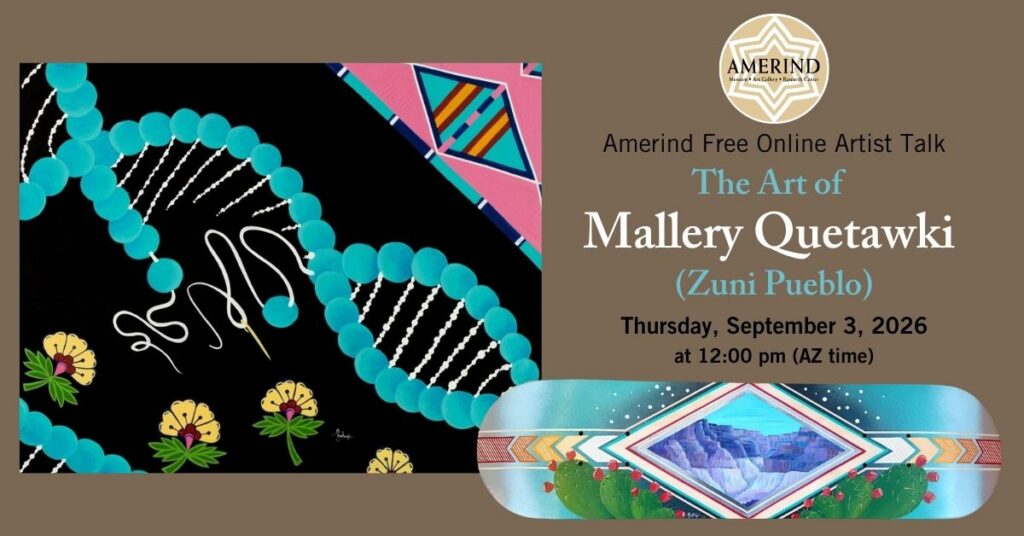
Online Artist Talk with Mallery Quetawki (Zuni Pueblo)

Amerind Free Online Artist Talk
Thursday, September 3, 2026
12:00 pm (AZ time)
To register, visit: https://bit.ly/Amerindonline09032026Quetawki

Please join us on Thursday, September 3, 2026, 12:00 pm for a free online artist talk, with Mallery Quetawki (Zuni Pueblo) and learn more about this fascinating artist who is using her talents to bridge art and science using her art as a tool to communicate scientific concepts regarding health and environmental topics to indigenous communities using traditional knowledge and art.

“I use art to help our Native communities understand concepts around environmental public health, especially individuals living in and around abandoned uranium mines,” Quetawki explained. “Many of these topics are complex, and some of the words do not exist in our indigenous languages. I help portray these ideas so that our relatives understand what is going on both in the environment and inside their bodies.”

Mallery is a painter, potter and muralist.

Mallery Quetawki (Zuni Pueblo) is Artist-in-Residence and Communications & Outreach Specialist with the University of New Mexico’s Community Environmental Health Program.  She is also a current 2025 Bloomberg American Health Initiative Fellow at the prestigious Johns Hopkins Bloomberg School of Public Health where she is in her first year as an MPH student.  Trained in biology and studio art (BS 09’, UNM), she specializes in translating complex environmental health research into culturally resonant visual narratives for Indigenous communities. Her work integrates Zuni symbolism with Western science to foster dialogue on topics such as uranium contamination, DNA damage, and immune health. Quetawki’s art has been exhibited nationally, including in the Metropolitan Museum of Modern Art’s Grounded in Clay exhibition, and is permanently displayed at the Indian Pueblo Cultural Center in Albuquerque.

We hope you will join us to learn more about this inspiring artist. 

Interested but not sure if you will be able to watch live? Register using an email and the recording will be sent to you later that evening.

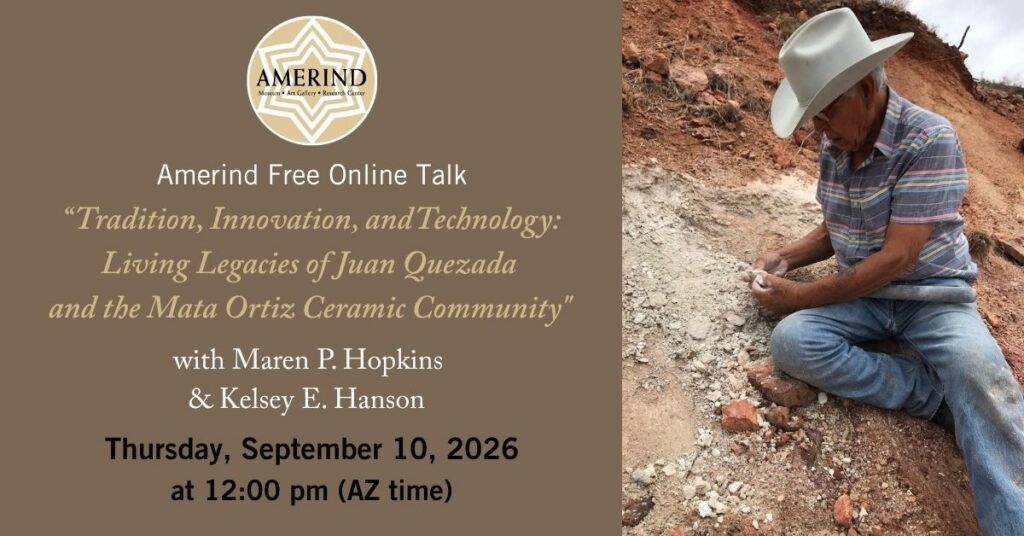
Amerind Online Talk: “Tradition, Innovation, and Technology: Living Legacies of Juan Quezada and the Mata Ortiz Ceramic Community”

Amerind Free Online Talk 
Thursday, September 10, 2026 
12:00 pm (AZ time) 
To register, visit:  https://bit.ly/Amerindonline09102026Hopkins

Join us on Thursday, September 10, 2026 at 12:00 pm (AZ time) for an online talk, “Tradition, Innovation, and Technology: Living Legacies of Juan Quezada and the Mata Ortiz Ceramic Community”, with Maren P. Hopkins and Kelsey E. Hanson  

 Juan Quezada (1940–2022) is celebrated internationally for pioneering the modern pottery tradition of Mata Ortiz, Chihuahua, through his extraordinary experimentation with local clays, pigments, and firing techniques inspired by the ancient ceramics of Paquimé. In this presentation, we explore Juan’s stories, memories, and observations about the places where he gathered clay. We compare his lifetime of experience with scientific compositional analyses of those clay sources. Together, these perspectives reveal that Juan’s artistry was more than technical skill—it emerged from a deep relationship with the land, shaped by curiosity, exploration, experimentation, and lived experience. 

 Maren Hopkins is an archaeologist and ethnographer with more than 26 years of experience leading cultural resource, ethnographic, and heritage projects throughout the U.S. Southwest and Mexico. She specializes in collaborative, community-based, and place-based research, working closely with knowledge holders and other stakeholders to document history, cultural traditions, and the diverse ways people understand, experience, and sustain meaningful places. Her work integrates archaeology, ethnography, and heritage conservation to advance public history, cultural preservation, land stewardship, and informed natural and cultural resource management. 

Dr. Kelsey Hanson is an Assistant Professor of Anthropology at the University of Texas at Arlington. Integrating interdisciplinary scientific methods with collaborative, community-based approaches to archaeology, her research explores the social roles of technology, materiality, and knowledge in the Greater Southwest and beyond. From compositional studies of pigments and ceramics to analyses of built environments and landscapes, her work examines how materials encode information about relationships to people, places, and knowledge. She draws from these connections in the past to contribute to contemporary efforts in cultural preservation and stewardship among diverse communities today. 

We hope you will join us!

*Unsure if you can watch the talk live? Register using an email and a recording of the talk will be sent later that evening.

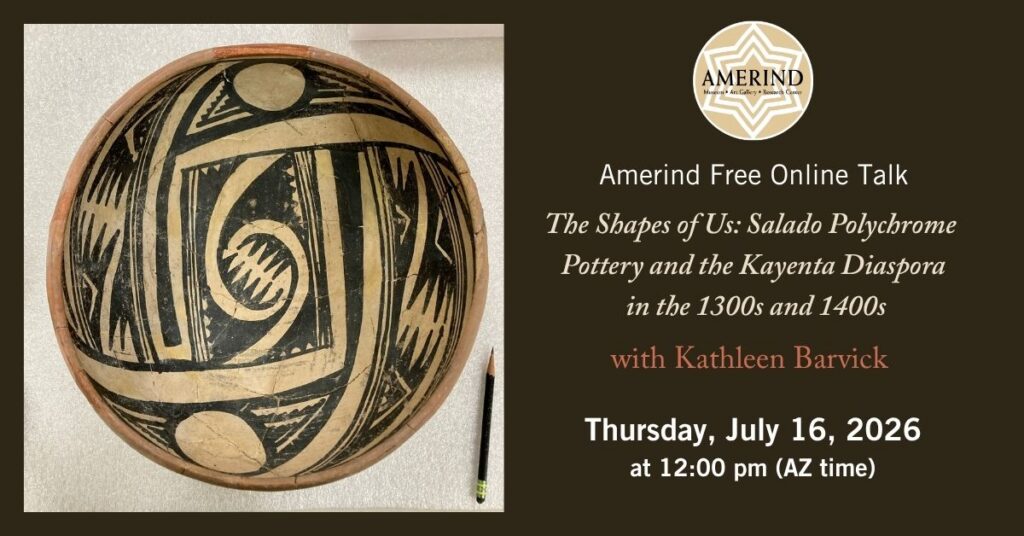
Free Online Talk: The Shapes of Us: Salado Polychrome Pottery and the Kayenta Diaspora in the 1300s and 1400s,” with Kathleen Barvick.

Amerind Free Online Talk
Thursday, July 16, 2026
12:00 pm (AZ time)
To register, visit: https://bit.ly/Amerindonline07162026Barvick

Join us on Thursday, July 16, 2026 at 12:00 pm (AZ time) for an online talk,The Shapes of Us: Salado Polychrome Pottery and the Kayenta Diaspora in the 1300s and 1400s” with PhD candidate Kathleen Barvick.

In the late 1200s, a massive drought hit the Southwest, causing political instability and sparking a massive migration as people left the Four Corners area and migrated south to settle along the rivers, which changed to social and political organization of the Southwest forever. One group of people, from the Kayenta region of northeastern Arizona, settled across a wide area of central and southern Arizona and western New Mexico, sometimes integrating into local settlements, sometimes setting up their own enclaves away from existing settlements. Dr. Barvick’s research focuses on Salado polychrome, a specific type of pottery that arose among these Kayenta immigrant communities and spread across Arizona and New Mexico. By looking at Salado polychrome pots across the Southwest, and specifically at the variation in their shapes, she investigates how the Kayenta immigrant diaspora shared technological practices regarding pottery creation across far-flung communities in the 1300s and 1400s, how the use of Salado polychrome spread, and how Kayenta immigrants negotiated their identities as Kayenta people and as immigrants in their new homes.

Dr. Kate Barvick is an archaeologist who studies pottery, migration, and community networks in the US Southwest. She grew up in Massachusetts and received a BA in Anthropology and Linguistics from the University of Massachusetts Amherst in 2018. Her archaeology experience in Massachusetts focused on 18th- and 19th-century historic house sites, with a special emphasis on the Revolutionary War era. Her research in the Southwest is both older than that (she spent several summers in northern New Mexico near Taos, on a collaborative community project with Picuris Pueblo) and more recent (she spent several years researching the history of baseball and its connection to labor movements in the 20th century in Bisbee, AZ). She brings from this background a passion for public archaeology, community engagement, and the bridging of the past and the present. She currently lives in Tucson, recently defended her PhD at the University of Arizona, and is the Amerind Emerging Scholar-in-Residence in Summer 2026.

If you are unsure if you can watch live, register using an email and the recording of the talk will be sent to you following the program.

We hope you will join us!

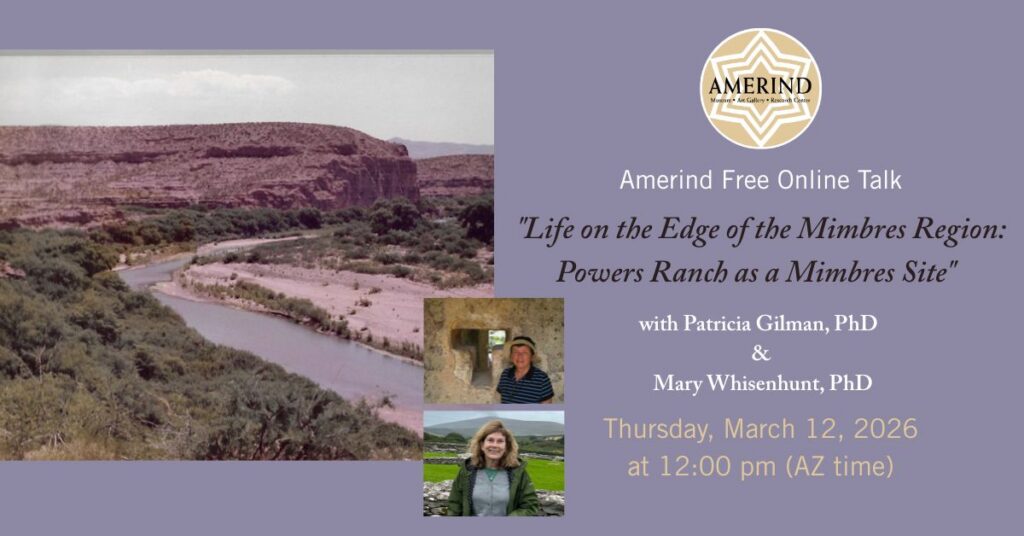
Free Online Talk: “Life on the Edge of the Mimbres Region: Powers Ranch as a Mimbres Site” with Patricia Gilman & Mary Whisenhunt

Free Online Talk
Thursday, March 12, 2026
12:00 pm – 1:00 pm (AZ time)
Life on the Edge of the Mimbres Region: Powers Ranch as a Mimbres Site” with Patricia Gilman, PhD & Mary Whisenhunt, PhD

To register, visit: https://bit.ly/Amerindonline03122026Gilman

Join us on Thursday, March 12, 2026 at 12:00 pm (AZ time) for an online talk, “Life on the Edge of the Mimbres Region: Powers Ranch as a Mimbres Site”, with Patricia Gilman, PhD and Mary Whisenhunt, PhD.

When people think of Mimbres archaeology, they picture beautiful black-on-white pottery with paintings of people and animals and large pueblo sites in the Mimbres Valley of southwestern New Mexico.  However, there were Mimbres sites beyond the Mimbres Valley, but they were different from those in the valley.  We explore what it meant to be Mimbres at the Powers Ranch site, a small settlement at the western edge of the Mimbres region. We conclude that the people at Powers Ranch were quintessentially Mimbres and were more closely affiliated with Mimbres settlements on the Gila River drainage in southeast Arizona and New Mexico than with those living in the Mimbres Valley core area.

Mary Whisenhunt received her anthropology doctorate in 2020, conducting her field work in southeast Arizona. Her research focused on the social resilience of precontact Indigenous people on the western boundary of the Mimbres region.

Patricia Gilman has done archaeological research in the Mimbres region for more than 50 years, retiring from the Department of Anthropology at the University of Oklahoma. One of her research foci has been Mimbres beyond the Mimbres Valley.

We hope you will join us!

If you can’t join us to watch live on March 12th, register using an email and the recorded talk will be sent to you after the talk, to watch at your leisure.


Online Artist Talk with Santiago Romero

Amerind Free Online Artist Talk

Thursday, November 20, 2025

12:00 pm (AZ time)

To register, visit: https://bit.ly/Amerindonline11202025Romero

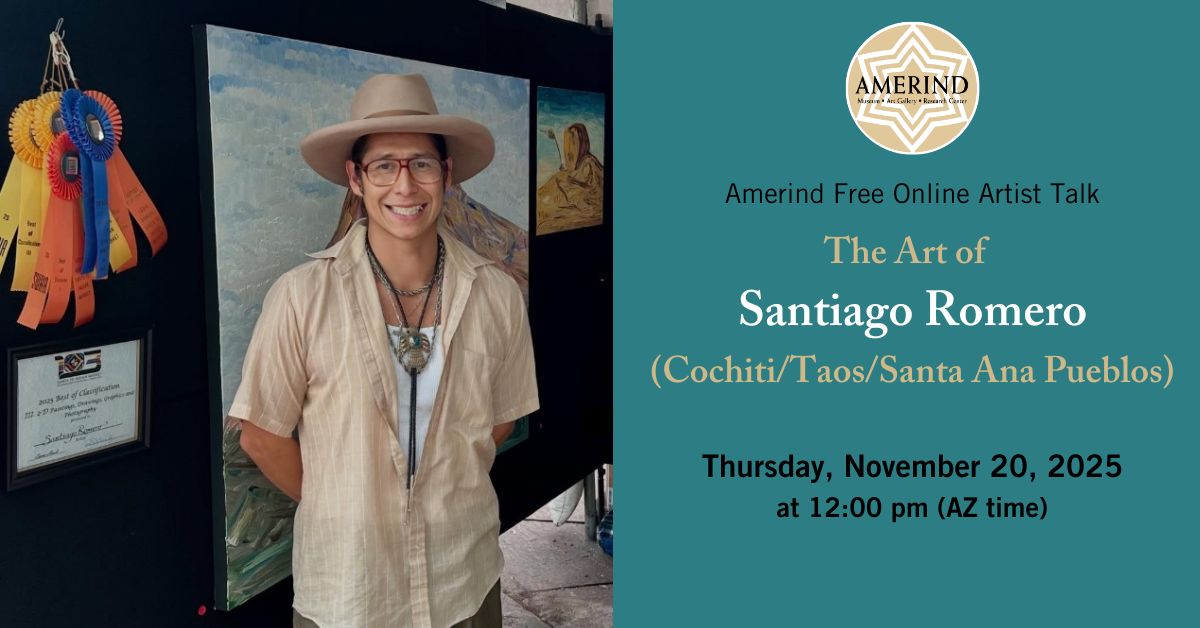
Please join us on Thursday, November 20, 2025 at 12:00 pm (AZ time) for an online artist talk, with painter and potter Santiago Romero (Cochiti/Taos/Santa Ana Pueblos).

Santiago Romero was born in Santa Fe, NM but grew up between New Mexico and the heart of Los Angeles. After graduating High school, he attended Dartmouth College and received a degree in environmental science. He returned to Santa Fe, where he was working as a ceramic sculptor and painter, as well as actively participating culturally in four separate Pueblo communities. He is currently working on his Master’s degree in Texas and continues to work on his art.

Santiago comes from a legacy of artists; his dad, Diego Romero, is a renowned potter from whom he learned traditional polishing and linework. His uncle, painter Mateo Romero, taught him about layout and gestural technique in painting. His artistic influences are many, but he believes the true force behind his artwork lies within his great-grandmother, Teresita Romero. As an artist of many forms herself, he has found himself guided by her work and spirit.

He strives to integrate his background, education, and experience into all his work by incorporating different techniques, both traditional and contemporary, reflecting who he is and where he comes from.

Santiago has won many awards for his work, including, most recently, the coveted “Best of classification in Painting, Photography, drawing, and photography” at this year’s Indian Market. His work can be found in top collections and galleries. In early 2025, Santiago completed an artist-in-residence at the Amerind, where he spent a month painting and honing his artistic skills. Please note the smaller painting in the photo above was painted here on the Amerind grounds, during his residency!

We hope you will join us to learn more about this fascinating young artist.

*Unsure if you will be able to join us live, register using an email and the talk will be sent to all registrants later that evening.