Guided Hikes with Dr. Eric Kaldahl

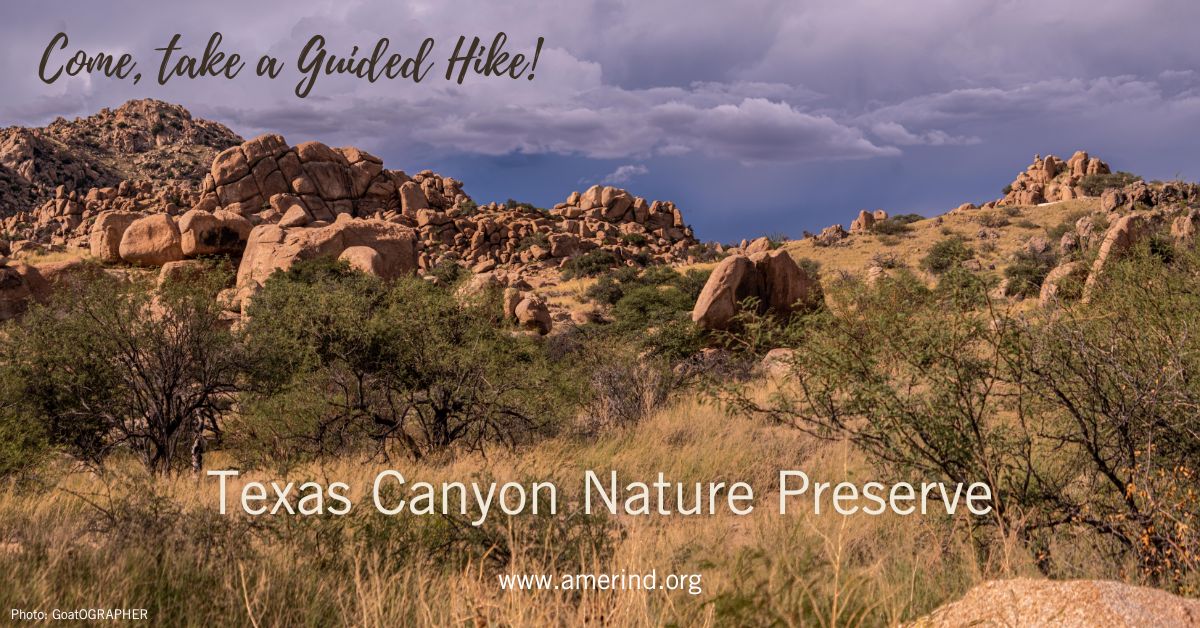
Come and take a Guided Hike with Amerind’s CEO Dr. Eric Kaldahl.
Hikes are FREE to all Amerind Members.

Guided hikes for non-members are $22 per adult; $20 seniors (62+) and youth (10-17). This fee includes admission to the Amerind Museum & Art Galley on the day of your hike.

Guided hikes are limited to 20 participants on a first-come, first-serve basis. You can sign up by calling the Amerind Museum Store at (520)586-3666.

Each program will involve 1-2 miles of hiking and last 2 hours. Participants should dress appropriately for the weather and hiking. Don’t forget your water and sun protection (even in winter months). As with all Amerind’s outdoor activities, participants will need to complete a recreational liability waiver just before the hike. All the Texas Canyon Nature Preserve hiking rules apply.

Geology Hikes: Learn more about Texas Canyon’s unique geologic landscape and its formation.

Friday, October 30, 2026, 9-11 am

Saturday, January 9, 2027, 9-11 am

Friday, February 5, 2027, 9-11 am

Friday, March 5, 2027, 8:30-11:30 am

Friday, April 16, 2027, 8:30-10:30 am

Ethnobotany Hikes: Learn about the plants used to make beautiful baskets and other tools. Participants will begin in the classroom with objects from the museum’s collection of contemporary Indigenous baskets and then go on the trails to see the plants used by weavers.

Friday, November 6, 2026, 9-11 am

Friday, January 29, 2027, 9-11 am

Friday, February 12, 2027, 9-11 am

Friday, March 12, 2027, 8:30-10:30 am

Friday, April 2, 2027, 8:30-10:30 am

*Bird Walks at the Amerind with Ornithologist Homer Hansen

Friday, November 20, 2026
8:00 am to 10:00 am
Beginner’s Bird Walk with Homer Hansen

Enjoy a casual walk around the Amerind while spending time learning and practicing basic bird identification skills. Time will be spent at the ponds and along the trails observing and identifying common bird species. Homer will have a spotting scope. Please bring your own binoculars if you have them, and be sure to bring a hat, good hiking shoes, and water.

Friday, March 26, 2027
7:30 am to 9:30 am
Birdwatching for Early Spring Migrants with Homer Hansen

During the month of March, early spring migrants start passing through southeast Arizona. Enjoy a casual walk around the Amerind while looking for returning birds. Time will be spent at the ponds and along the trails observing and identifying our migratory (and resident) bird species. Homer will have a spotting scope. Please bring your own binoculars if you have them, and be sure to bring a hat, good hiking shoes, and water.

Fees and reservations are the same as above and again hikes are limited to 20 participants on a first-come, first-serve basis. Please sign up by calling the Amerind Museum Store at (520)586-3666.

Free to Amerind Members

If you love the outdoors, the most cost effective is a 1-year $50 Nature Club Membership gives two adults and any children or grandchildren under 18 access to the hiking trails at no extra cost during our open hours. This membership will also give you access to guided hikes like these at no extra cost. Nature Club Members also receive four guest passes which you can use to visit the Amerind museum or give away to friends and family. Nature Club Members also get 10% off items in our Museum Store.

Visit our Membership page to learn more.

Vintage Basketry and Weavings with Terry DeWald

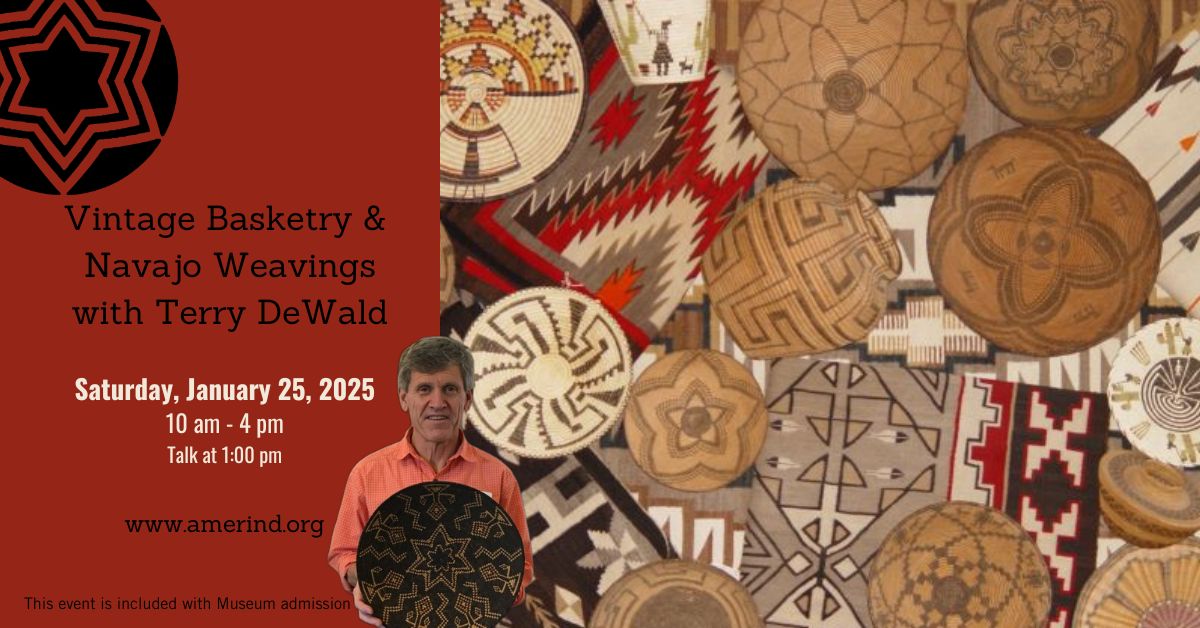
Vintage Basketry and Navajo Weavings show with Terry DeWald

Saturday, January 25, 2025

10:00 am – 4:00 pm

Talk at 1:00 pm

Please join us on Saturday, January 25, 2025, when we host Terry DeWald for a Vintage Basketry and Navajo Weavings Show at the Amerind Museum. The show will feature vintage Navajo weavings and baskets from California, the greater Southwest, and contemporary Tohono O’odham baskets.

DeWald has been a prominent dealer, lecturer, appraiser, and author of Native American art for more than 40 years.

Come and learn all about this beautiful art, have questions? Terry’s the one to ask! Also, remember that you do not pay sales tax on purchases from the Amerind Museum. Your purchases directly support Amerind’s work with Indigenous artists, museum collections, and public programming.

Terry will give a talk at 1:00 PM

This event is included with regular Museum admission.

Vintage Basketry & Navajo Weavings with Terry DeWald

 Vintage Basketry and Navajo Weavings with Terry DeWald

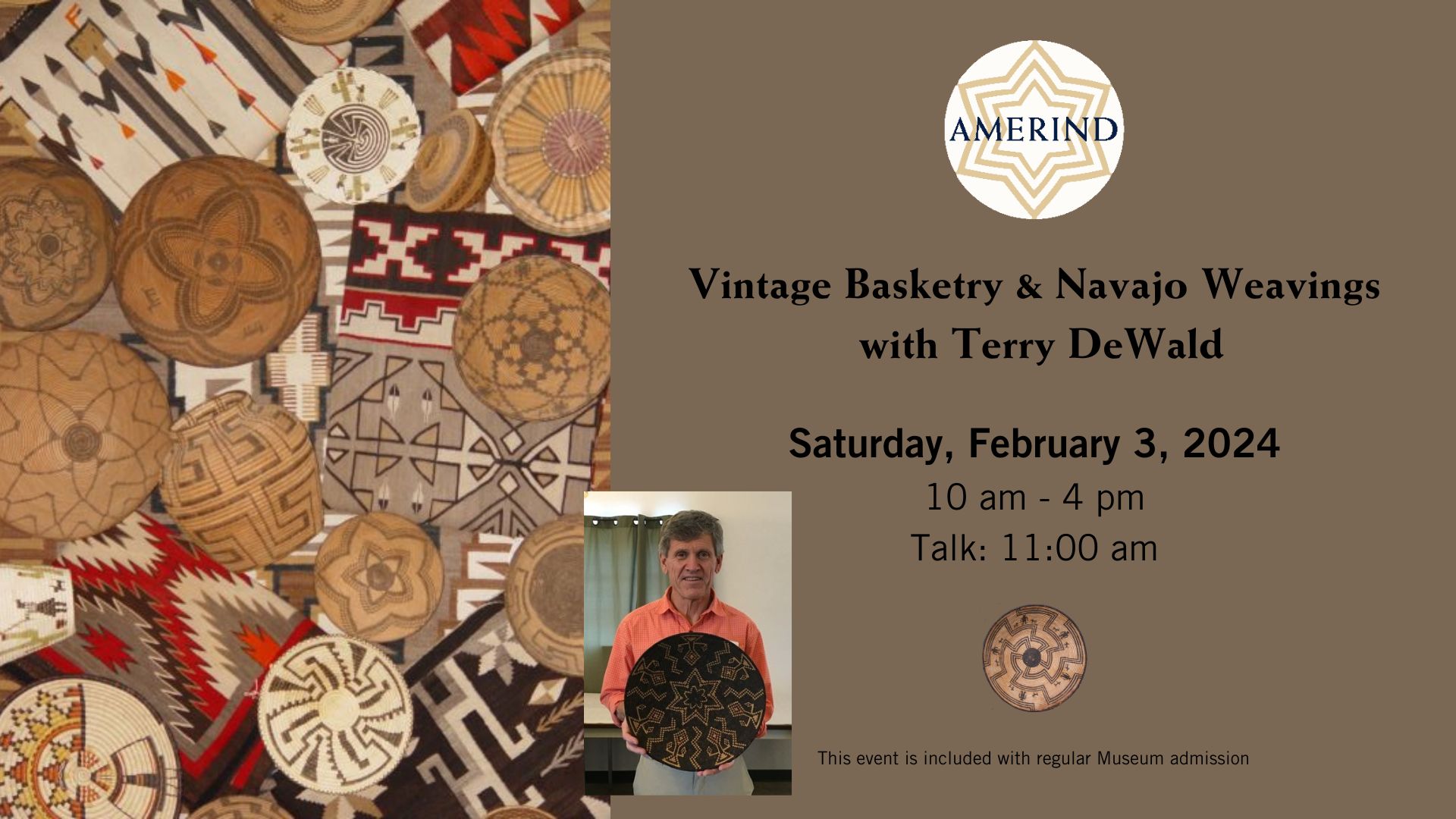
Saturday, February 3, 2024

10:00 am – 4:00 pm

Talk: 11:00 am

 Please join us on Saturday, February 3, 2024, when we host Terry DeWald of Terry DeWald American Indian Art for a Vintage Basketry and Navajo Weavings Show & Sale at the Amerind Museum. The show will feature vintage Navajo weavings, vintage baskets from California, the greater southwest, and contemporary Tohono O’odham baskets.

DeWald has been a prominent dealer, lecturer, appraiser, and author of Native American art for more than 40 years.

DeWald will give a talk on Vintage Basketry and Navajo Weavings at 11:00 am.

This event is included with regular Museum admission.

Amerind Free Online Artist Talk: Writing our Stories with Diné (Navajo) Master Weavers Barbara Teller Ornelas and Lynda Teller Pete

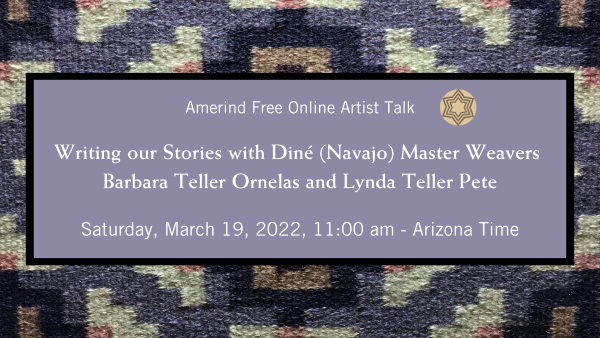
Weaving by Navajo Master Weaver Lynda Teller Pete, with geometric shapes in lavender, white, and light brown.

Amerind Free Online Artist Talk Writing our Stories with Diné (Navajo) Master Weavers Barbara Teller Ornelas and Lynda Teller Pete

Amerind Free Online Artist Talk

Writing our Stories with Diné (Navajo) Master Weavers Barbara Teller Ornelas and Lynda Teller Pete

Saturday, March 19, 2022, 11:00 am – Arizona Time

Amerind welcomes Diné (Navajo) master weavers Barbara Teller Ornelas and Lynda Teller Pete for the free online talk, “Writing our Stories.” Fifth-generation weavers who grew up at the fabled Two Grey Hills trading post, Barbara and Lynda are considered among the very most skillful and artistic of Diné weavers today. During their presentation Barbara and Lynda will discuss the experience of writing their book “Spider Woman’s Children,” a work delving into the realm of Diné weaving.

Barbara Jean Teller Ornelas is a fifth-generation Master Navajo Weaver and culture bearer, raised near the famed Two Grey Hills Trading Post on the Navajo Nation. Her father, Sam Teller (1918–2000), was a Navajo trader for thirty-two years, and her mother, Ruth Teller (1928–2014), was a weaver, gardener, quilter and photographer. When Teller Ornelas was ten, her paternal grandmother dreamt that her granddaughter would become a great weaver who shared their traditions around the world. Fifty-six years later, Teller Ornelas has not only honed her artistry as a Two Grey Hills weaver, but shared it with audiences internationally in the form of workshops, lectures, and exhibitions.

For Teller Ornelas, weaving is a living thing, and she uses her weavings to tell stories—a legacy passed down by her great-grandfather, a Keeper of Stories who was a prisoner of war at Bosque Redondo after the U.S. military forcibly relocated the Navajo people in 1863. Teller Ornelas is herself a survivor of two U.S. government residential schools—institutions which aimed to eradicate Navajo culture. In the face of this, she has dedicated her life to preserving and innovating Navajo weaving. Her designs reference both her matrilineal traditions and lived experience. As a teacher, she has shared her knowledge with students from Arizona, to Peru, to Uzbekistan, building solidarity with other indigenous peoples. Today, her mission is to connect Navajo people in her own cultural ecosystem with their heritage by passing on this crucial ancestral knowledge, and nurturing new generations of Navajo weavers.

Navajo tapestry weaver Lynda Teller Pete was born into the Tábąąhá (Water Edge Clan) and born for the Tó’aheedlíinii (Two Waters Flow Together Clan).  Originally from the Two Grey Hills, Newcomb, NM areas of the Navajo Nation.  She lives in Denver with her husband Belvin Pete. Weaving is a legacy in the Teller family. For over seven generations, her family has produced award-winning rugs in the traditional Two Grey Hills regional style. Along with her weaving, Lynda is collaborating with fiber art centers, museums, universities, fiber guilds and other art venues to educate the public about Navajo history and the preservation of Navajo weaving traditions. Lynda and her sister Barbara wrote Spider Woman’s Children, Navajo Weavers Today in 2018. This book is the first book written about Navajo weavers by Navajo weavers since the time of Spanish and colonial contacts. Lynda has also collaborated with three authors on the book, Navajo Textiles: The Crane Collection at the Denver Museum of Nature and Science in 2016. Lynda has a Bachelor of Science degree in Criminal Justice in Public Programs from Arizona State University.  Lynda and Barbara’s new book “How To Weave a Navajo Rug and Other Lessons from Spider Woman” published by Thrums Books/Schiffer Publishing is now available.

From the age of six, when Lynda was officially introduced to weaving, instilled the belief that beauty and harmony should be woven into every rug. “In our Teller family, we regard weaving as our life’s work. Weaving represents our connection to the universe. It is our stories, our prayers, and our songs that are told, chanted, sung, and preserved in the weaving motions. Every weaver has stories to tell about his or her weaving, and every weaving has stories to tell about the weaver: the sights, the sounds, the smells, and the signature styles. And each weaver is unique. I touch tapestries woven by my grandmothers, my mother, my sisters, my cousins, my niece, my nephew, my granddaughter, my grandson and I see their hands strumming the warps. I hear the resonating beats of their weaving combs, and without seeing them, I know who is weaving just by the sound of their beats. I see tears, fears, and joy, and I hear laughter, soothing words of comfort, and loud congratulatory cheers. Unlike our elder Navajo weavers, people will know our names; they will see our faces, know our stories, and they will hear our songs and our prayers on each tapestry that we create.” Today, Lynda Teller Pete continues to carry this weaving tradition.

This online program is free, but space is limited. To register visit: https://bit.ly/AmerindOnline031922