Free Public Talk “Can Tomorrow’s AI Help Us Protect the Past?” with Dr. Jonathan Paige

Free Public Talk Saturday, March 7, 1-2 PM, Tucson
Can Tomorrow’s AI Help Us Protect the Past?
with Dr. Jonathan Paige
Presentation will be at the Tucson Museum of Art, 140 North Main Avenue
in the Alice Chaiten Baker Education Center

Archaeological sites are an irreplaceable part of our human heritage. How can we best protect them? How can we best find them? How can we learn from them?

The archaeological record represents over three million years of human behavior. However, it is challenging for us to integrate data and information from projects carried out by generations of researchers. The challenge of integrating data needs to be overcome if we are to synthesize information about the record, answer big questions about the human past, and protect the archaeological record itself.

Dr. Paige and a team of global researchers with the Coalition for Archaeological Synthesis are examining ways that Artificial Intelligence can help the archaeologists of tomorrow. Paige discusses the results of their group’s work, focusing on current approaches in using AI to protect and study the archaeological record, and their vision for how AI may be used in the future.

About the Speaker

Dr. Jonathan Paige is a Co-Director and Research Scientist with the Cultural Resource Sciences program, Center for Applied Fire and Ecosystem Science, New Mexico Consortium. He studies the evolution of technologies, the role they play in human evolution, and how groups adapt to new and challenging environments. He also works with federal agencies on advancing their capacity to perform comparative research through machine learning, developing models to identify archaeological sites on remote sensing imagery.

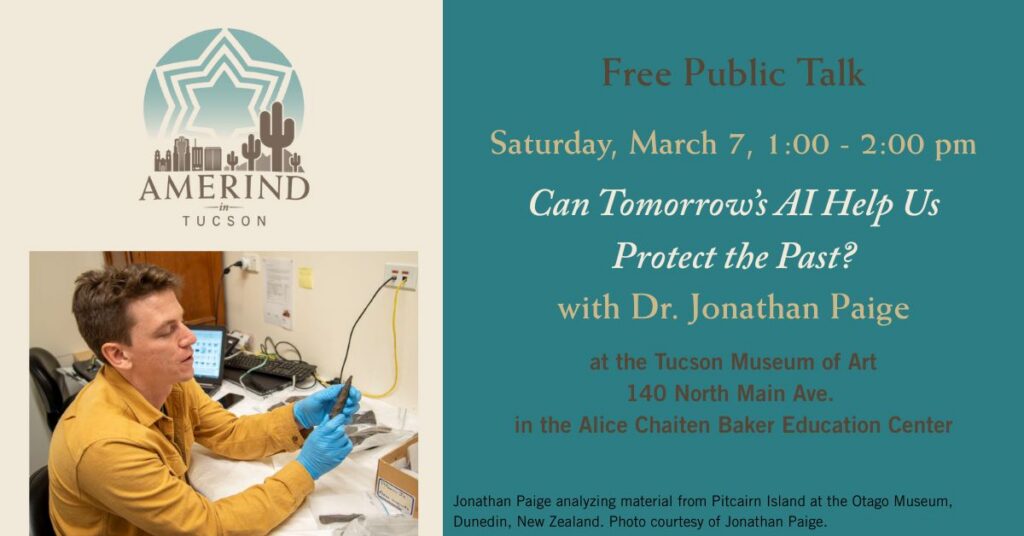
Photo Caption: Jonathan Paige analyzing material from Pitcairn Island at the Otago Museum, Dunedin, New Zealand. Photo courtesy of Jonathan Paige.

We hope you will join Amerind in Tucson!

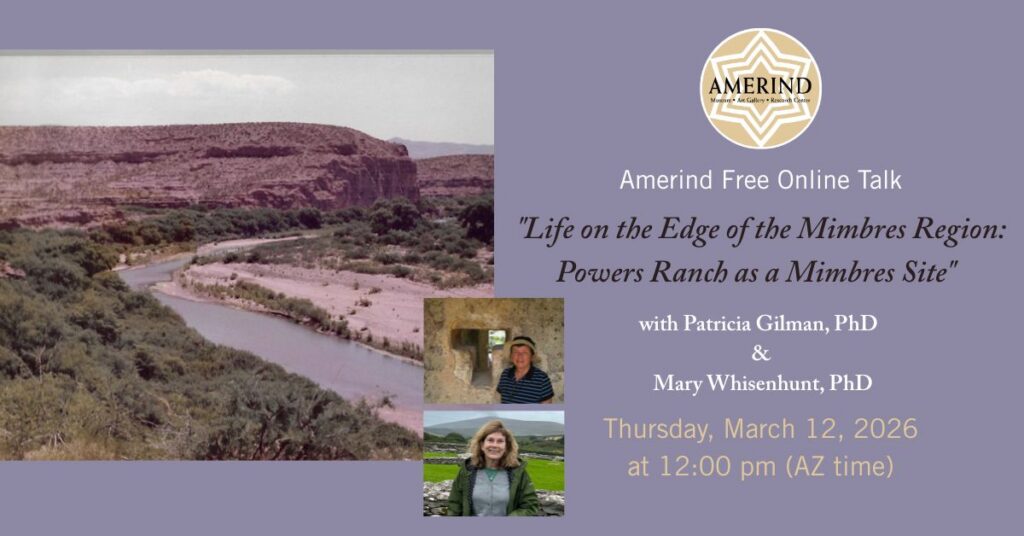
Free Online Talk: “Life on the Edge of the Mimbres Region: Powers Ranch as a Mimbres Site” with Patricia Gilman & Mary Whisenhunt

Free Online Talk
Thursday, March 12, 2026
12:00 pm – 1:00 pm (AZ time)
Life on the Edge of the Mimbres Region: Powers Ranch as a Mimbres Site” with Patricia Gilman, PhD & Mary Whisenhunt, PhD

To register, visit: https://bit.ly/Amerindonline03122026Gilman

Join us on Thursday, March 12, 2026 at 12:00 pm (AZ time) for an online talk, “Life on the Edge of the Mimbres Region: Powers Ranch as a Mimbres Site”, with Patricia Gilman, PhD and Mary Whisenhunt, PhD.

When people think of Mimbres archaeology, they picture beautiful black-on-white pottery with paintings of people and animals and large pueblo sites in the Mimbres Valley of southwestern New Mexico.  However, there were Mimbres sites beyond the Mimbres Valley, but they were different from those in the valley.  We explore what it meant to be Mimbres at the Powers Ranch site, a small settlement at the western edge of the Mimbres region. We conclude that the people at Powers Ranch were quintessentially Mimbres and were more closely affiliated with Mimbres settlements on the Gila River drainage in southeast Arizona and New Mexico than with those living in the Mimbres Valley core area.

Mary Whisenhunt received her anthropology doctorate in 2020, conducting her field work in southeast Arizona. Her research focused on the social resilience of precontact Indigenous people on the western boundary of the Mimbres region.

Patricia Gilman has done archaeological research in the Mimbres region for more than 50 years, retiring from the Department of Anthropology at the University of Oklahoma. One of her research foci has been Mimbres beyond the Mimbres Valley.

We hope you will join us!

If you can’t join us to watch live on March 12th, register using an email and the recorded talk will be sent to you after the talk, to watch at your leisure.


Free Online Talk “Our Elder Brother Dwells There: How I’itoi Ki Moved from Mountain Peak to Basket Design.” with David Martinez, PhD.

Photo: Early 20th Century O’odham Basket with “Man in the Maze” design, 13 1/4″ dia., Amerind permanent collection

Amerind Free Online Talk

Thursday, February 12, 2026

12:00 pm (AZ time)

Our Elder Brother Dwells There: How I’itoi Ki Moved from Mountain Peak to Basket Design.” with David Martinez, PhD. (Akimel O’odham/Hia-Ced O’odham/Mexican)

To register, visit: https://bit.ly/Amerindonline02122026Martinez

Join us on Thursday, February 12, 2026 at 12:00 pm (AZ time) for a free online talk, “Our Elder Brother Dwells There: How I’itoi Ki Moved from Mountain Peak to Basket Design.” with Dr. David Martinez.

“Learn about I’itoi, Elder Brother, who taught O’odham how to live well in their desert homelands. Learn where his home, his kih, is located, according to oral tradition. Most importantly, learn about how the symbol of this home, I’itoi kih, started appearing in O’odham baskets more than a century ago. What does it all mean?”

David Martínez (Akimel O’odham/Hia-ced O’odham/Mexican), Is a Professor of American Indian Studies and Transborder Studies at Arizona State University. He is the author of the forthcoming The Maze of History: Komal Hok, O’odham Teachings, and an Earth-Based Sense of Time (University of New Mexico Press, April 2026).

Martínez is also the author of Dakota Philosopher: Charles Eastman and American Indian Thought (Minnesota Historical Society Press, 2009), Life of the Indigenous Mind: Vine Deloria Jr and the Birth of the Red Power Movement (University of Nebraska Press, 2019), My Heart Is Bound Up With Them: How Carlos Montezuma Became the Voice of a Generation (University of Arizona Press, 2023), and editor of The American Indian Intellectual Tradition: An Anthology of Writings from 1772 to 1972 (Cornell University Press, 2011).

Dr. Martínez is also the director and founder of the Institute for Transborder Indigenous Nations (ITIN), which is housed in the School of Transborder Studies at ASU, where it focuses on Indigenous nations impacted by the US-Mexico Border.

Interested but unsure if you will be able to join us live? Register using an email and the recording of the talk will be sent later that evening to all registrants.

We hope you will join us for this fascinating talk.


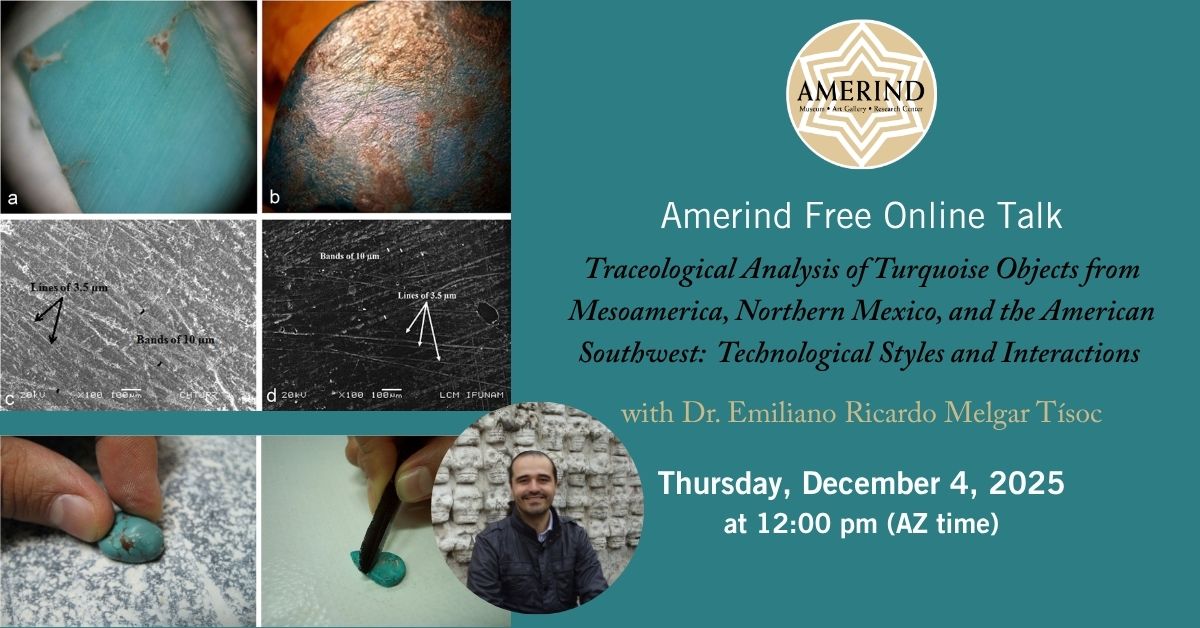
Amerind Free Online Talk-Traceological Analysis of Turquoise Objects from Mesoamerica, Northern Mexico, and the American Southwest: Technological Styles and Interactions with Dr. Emiliano Ricardo Melgar Tísoc.

Amerind Free Online Talk

Thursday, December 4, 2025

12- 1 pm (AZ time)

To register, visit: https://bit.ly/Amerindonline12042025Tisoc

Traceological Analysis of Turquoise Objects from Mesoamerica, Northern Mexico, and the American Southwest: Technological Styles and Interactions with Dr. Emiliano Ricardo Melgar Tísoc.

There are thousands of turquoise objects found in different archaeological sites of Mesoamerica, Northern Mexico, and the American Southwest. Unfortunately, most of the researches about them had been focused on the symbolic meaning, its morphology, trade and use, but very few study their manufacturing traces. In this lecture, I will present a traceological approach to analyze and characterize their manufacturing techniques through the employment of Experimental Archaeology and Scanning Electron Microscopy (SEM). The comparison of the turquoise assemblages from more than fifty sites located in these regions showed specific patterns related with lapidary traditions and technological styles. With this new data of the geography of the manufacturing techniques, it is possible to appreciate new nodes of interactions and trends of circulation of the turquoise pieces (raw materials, blanks, and finished objects) among the sourcing areas, the workshops, and the final consumers.

Dr. Emiliano Ricardo Melgar Tísoc earned a BA in Archaeology from the National School of Anthropology and History (ENAH) in Mexico and an MA and Ph.D. in Anthropology from National Autonomous University of Mexico (UNAM). Since 2004 he has been a full-time researcher at the Templo Mayor Museum. Dr Melgar’ research has been awarded the 2010 Alfonso Caso Award for best bachelor thesis in archaeology, the 2011 Teotihuacan Award for best essay on the materials of that city, and the 2019 Award of the Mexican Academy of Sciences for the best young researcher in the Mexican Humanities. He has written five books and more than 80 articles for domestic and foreign publications. His latest book, “Lapidary Objects from the Great Temple: Styles and Technological Traditions”, received the Honorable Mention in the 2024 INAH Prize for the best archaeological research in Mexico.

We hope you will spend your lunch with us learning about the incredible work of Dr. Melgar Tísoc!

*Unsure if you will be able to watch live? Register using an email and you will be sent a recording of the talk later that evening.

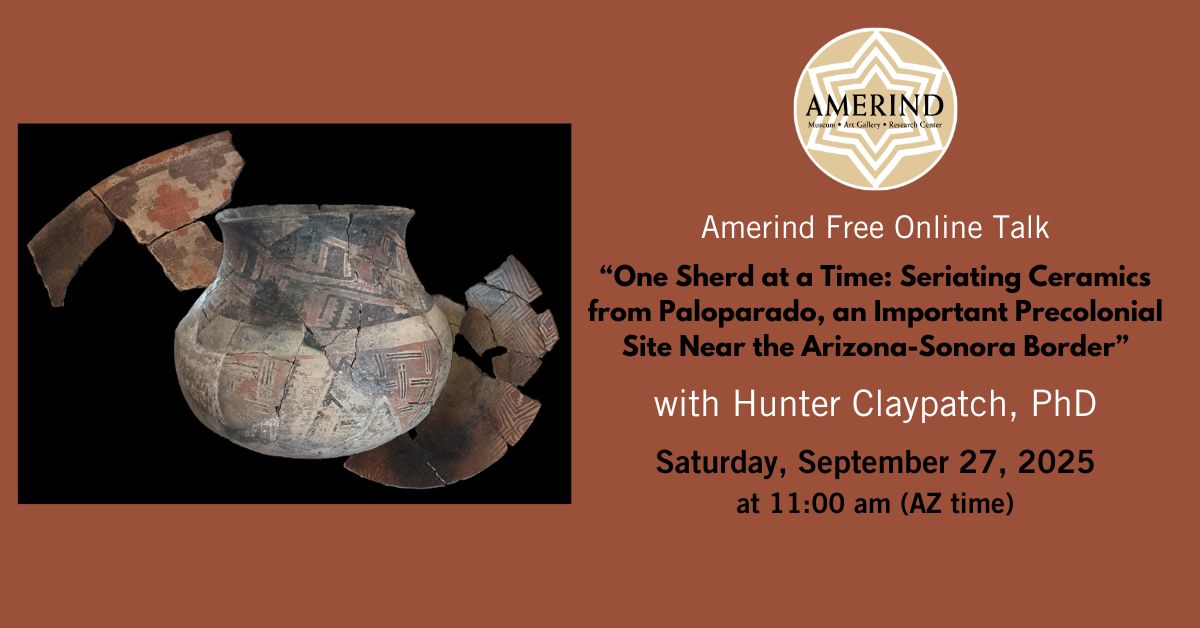
Amerind Free Online Talk-One Sherd at a Time: Seriating Ceramics from Paloparado, an Important Precolonial Site Near the Arizona/Sonora Border with Hunter Claypatch, PhD

Amerind Free Online Talk

Saturday, September 27, 2025

11:00 am (AZ time)

To register, visit: https://bit.ly/Amerindonline09272025Claypatch

Join us on Saturday, September 27, 2025 at 11:00 am (AZ time) for an online talk One Sherd at a Time: Seriating Ceramics from Paloparado, an Important Precolonial Site Near the Arizona-Sonora Border with Scholar Hunter Claypatch, PhD

The archaeological site of Paloparado is located within present-day Santa Cruz County, Arizona. It was excavated in the 1950s by Charles Di Peso and the Amerind Foundation. Although fundamental for reconstructing the occupational history of the Arizona-Sonora borderlands, the excavation was conducted with little prior knowledge of regional ceramics and many of Di Peso’s original interpretations have long been refuted. Through Amerind’s Emerging Scholar Residency, Claypatch applied ceramic insights that were unknown in the 1950s to conducted a systematic reanalysis of Paloparado’s pottery. Coupled with previously unpublished site data, this research reconstructs the occupational history of Paloparado and demonstrates the presence of largely unmixed Pre-Classic (pre-1150 CE) house deposits.

Hunter M. Claypatch received his Ph.D. from Binghamton University in 2022. He is a ceramicist who has worked extensively with precolonial pottery on both sides of the U.S. and Mexico international border. He specializes in Trincheras tradition of northern Sonora and the precolonial inhabitants of present-day Santa Cruz County, Arizona. His research applies traditional seriations, practice theory, and models for cultural connectivity to reconstruct Indigenous lifeways. He currently serves as president-elect for the Arizona Archaeological Council and as a professor at Pima Community College, in Tucson, Arizona.

We hope you will join us!

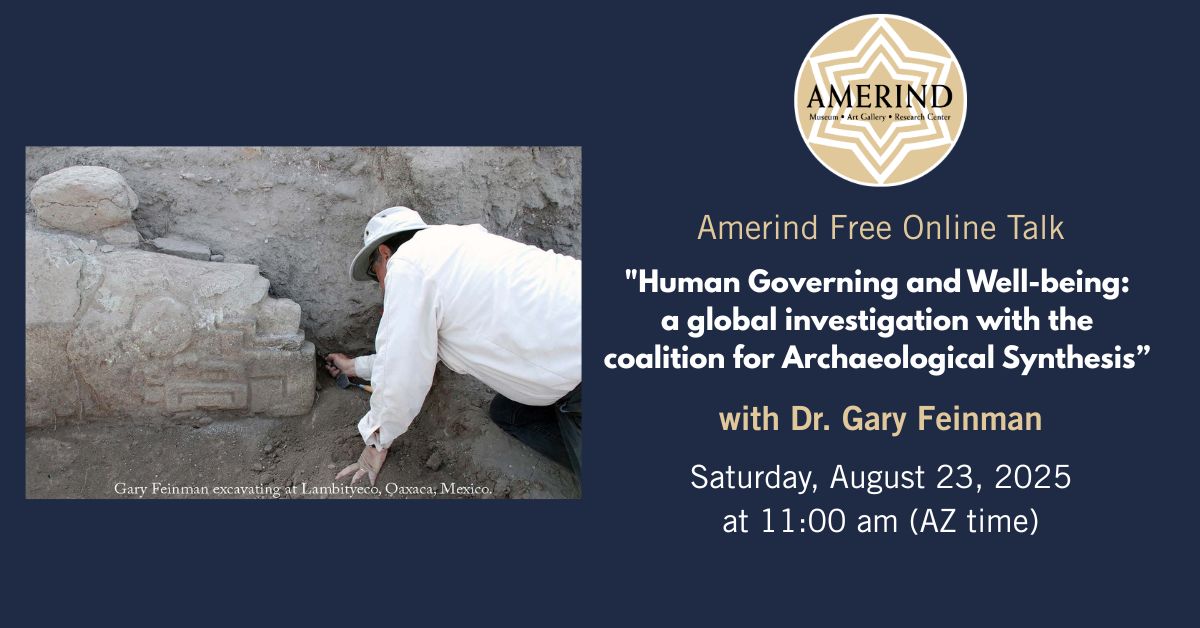
Amerind Free Online Talk- Human Governing and Well-being: a global investigation with the coalition for Archaeological Synthesis with Dr. Gary Feinman

Amerind Free Online Talk

Saturday, August 23, 2025

11:00 am (AZ time)

Join us on Saturday, August 23, 2025 at 11:00 am (AZ time) for an online talk, “Human Governing and Well-being: a global investigation with the coalition for Archaeological Synthesis” with Dr. Gary Feinman (Field Museum of Natural History).

How can we learn from our ancestors to make a better world for tomorrow? Dr. Gary Feinman and an international team of social scientists with the Coalition of Archaeological Synthesis are examining dozens of ancient societies on several continents. Their goal is to better understand how the governing systems humans create affect the practices and well-being of their people. From these insights, they hope to draw lessons that can help create governing systems that allow people to thrive. Amerind’s community has helped support their convenings.

Dr. Feinman is the MacArthur Curator of Mesoamerican, Central American, and East Asian Anthropology at the Field Museum of Natural History. Feinman presently co-directs two international archaeological field projects in Mesoamerica and China. Earlier in his career, Feinman had leadership roles in the Valley of Oaxaca and the Ejutla Valley Settlement Pattern Projects and supervised residential excavations at four sites in the region. For 30 field seasons, he has been co-directing fieldwork in China’s eastern Shandong Province.

To register, visit: https://bit.ly/Amerindonline08232025Feinman

Not sure you can watch live, register with an email and you will be sent the recording of the talk to watch at your leisure after the talk.


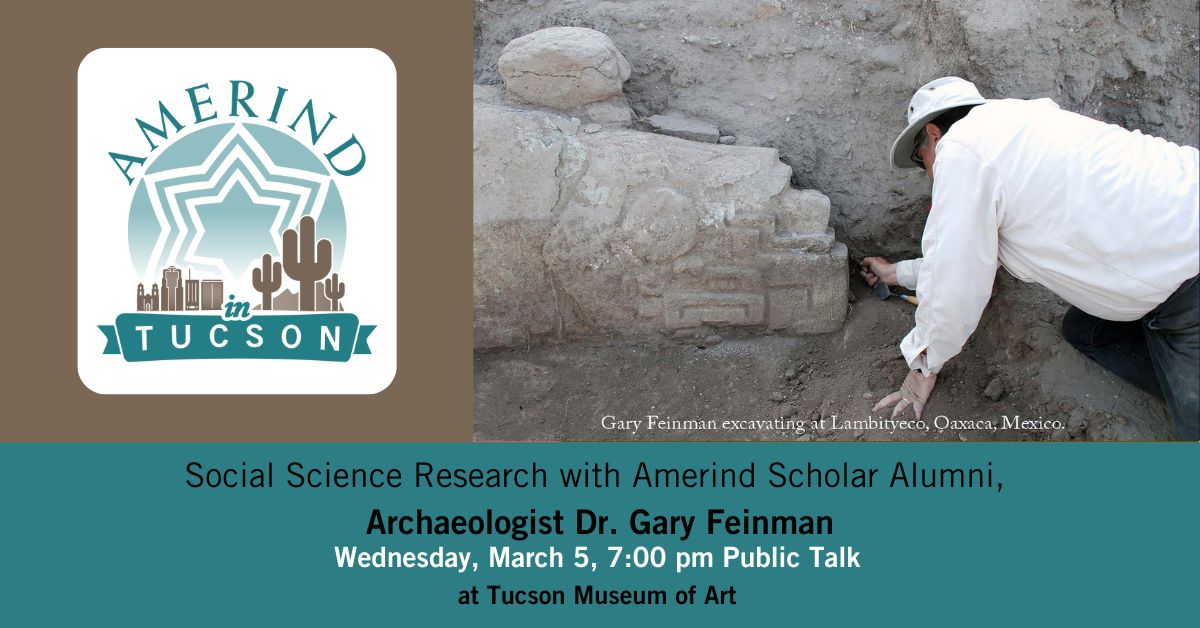
Social Science Research with Amerind Scholar Alumni, Dr. Gary Feinman

Social Science Research with Archaeologist Dr. Gary Feinman (Field Museum of Natural History)

Wednesday, March 5, 2025

7:00 pm Public Talk

FREE event

Tucson Museum of Art- 140 N. Main Ave. Tucson, AZ.

Join us in Tucson for a public talk with Senior researcher Dr. Gary Feinman of the Field Museum of Natural History, and a global team of researchers are engaged in a remarkable project to learn how human well-being is affected by the kinds of governments we create. How can we learn from our ancestors to make a better world for tomorrow? Dr. Feinman and his team of social scientists are examining dozens of ancient societies on several continents. Their goal is to better understand how the governing systems humans create affect the health and well-being of their people. From these insights, they hope to learn how we can create governing systems that help people thrive. Amerind’s community has helped support these convenings.

Dr. Feinman is the MacArthur Curator of Mesoamerican, Central American, and East Asian Anthropology at the Field Museum of Natural History.  Feinman presently co-directs two international archaeological field projects in Mesoamerica and China. Early in his career, Feinman had leadership roles in the Valley of Oaxaca and Ejutla Valley Archaeological Projects. For 19 field seasons, he has been leading fieldwork in China’s eastern Shandong Province.

We hope you will join us on March 5th.

Thank you to our sponsor:


Book-Signing and Talk with Authors Henry Haven, Dale Nations, PhD and, Max Goldtooth, Sr.

Saturday, November 23, 2024

11 am – 12 pm

Join us for a book signing with authors Heny Haven and Dale Nations, PhD & Max Goldtooth, Sr., who will be signing their book “Navajo Traditional Stories and the Science of Geology” by Dale Nations, Henry Haven & Max Goldsmith, Sr.

Geologist Henry Haven (Dine’) will also give a talk.

The three authors of this book vary greatly in backgrounds and experience but share in the love of the land and a desire to impart their knowledge of it. Comparisons are made of the rock record of geologic events known to geologists, to the legends in stories known to traditional Navajos. Ages and environments of deposition of stratigraphic units progress from the two billion-year-old rocks that are exposed in the Inner Gorge of the Grand Canyon to succeeding rock units known to exist on and under the lands of Dine ‘Bikeyah across the Colorado Plateau that were formed a few million years ago or less. Geologists use observed fossil records and other geologic events to establish a Universal Geologic Time Scale that consists of four Eras of geologic time: the Precambrian, Paleozoic, Mesozoic, and Cenozoic eras. Navajo medicine men tell stories of their vision of the First Dark World, the Second Blue World, the Yellow Third World, and the Fourth White World. The stories show a major cycle of life beginning and extinction of variety of different species in the four worlds as does the geologic history in the four geologic eras.

*This event is included with Museum admission

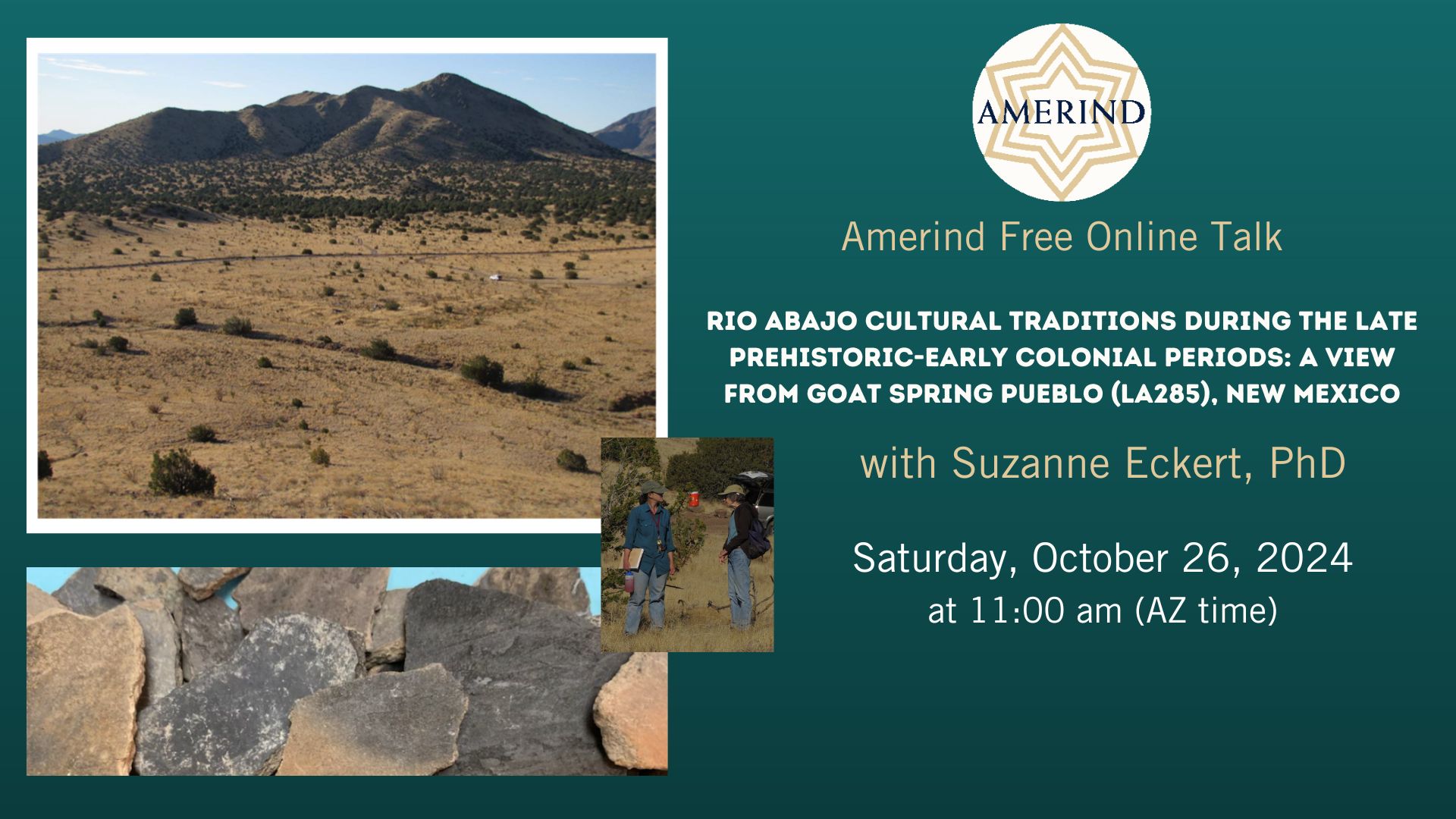
Amerind Free Online Talk: “Rio Abajo Cultural Traditions during the Late Prehistoric-Early Colonial Periods: A View from Goat Spring Pueblo (LA285), New Mexico” with Suzanne Eckert, PhD

Amerind Free Online Talk

“Rio Abajo Cultural Traditions during the Late Prehistoric-Early Colonial Periods: A View from Goat Spring Pueblo (LA285), New Mexico” with Suzanne Eckert, PhD

Saturday, October 26, 2024, 11:00 am – Arizona time

“Rio Abajo Cultural Traditions during the Late Prehistoric-Early Colonial Periods: A View from Goat Spring Pueblo (LA285), New Mexico”

Located at a little over 6,000 feet in elevation along the eastern edge the Cibola National Forest, Goat Spring Pueblo overlooks the Plano San Lorenzo of the Rio Abajo floodplain. It has been suggested that Rio Abajo villages played a major role in late Ancestral Pueblo Period (A.D. 1300-1680) social dynamics. For example, a major trail between the Western Pueblo and Rio Grande regions passed near Goat Spring Pueblo before ending near modern day Socorro. Given this known trail, the Rio Abajo may have been a gateway for the movement of people, cosmological ideas and ritual practices, as well as goods between the Rio Grande and Western Pueblo regions. This lecture considers recent excavations at Goat Spring Pueblo that have contributed to a much better understanding of cultural change and continuity in this region during this time.

Suzanne L. Eckert is the Head of Collections at the Arizona State Museum.  She earned her doctorate in 2003 from the Department of Anthropology, Arizona State University.  Dr. Eckert’s research focuses on how late Ancestral Pueblo cultures organized ceramic technology. She is especially interested in how this technology integrated with other aspects of society, including migration, political and social organization, religious practice and ideology, and gender and ethnic relations.

Register here: https://bit.ly/Amerindonline10262024Eckert

Amerind Free Online Talk: Capturing Water in Chaco Canyon and the Legacy of R. Gwinn Vivian, with Samantha Fladd, PhD

Amerind Free Online Lecture

Capturing Water in Chaco Canyon and the Legacy of R. Gwinn Vivian

with Samantha Fladd, PhD

Saturday, April 6, 2024, 11:00 am – Arizona Time


Capturing Water in Chaco Canyon and the Legacy of R. Gwinn Vivian

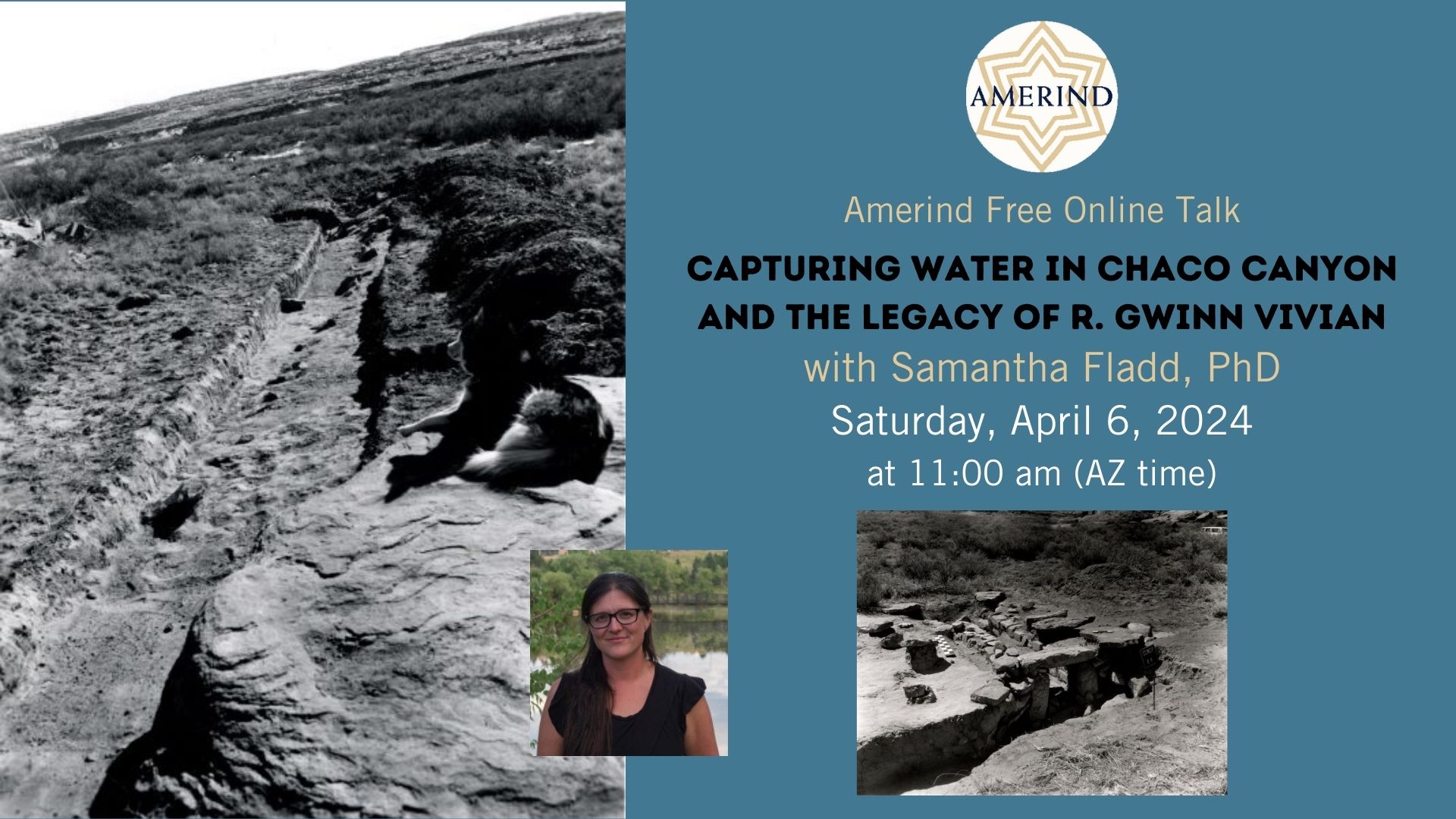
While Chaco Canyon is renowned for massive great houses and concentrations of nonlocal materials, the ability of residents to productively farm the arid landscape has remained contentious within archaeology. These debates have ranged from questions over soil quality to the existence and use of water management features. Throughout his career, Dr. R. Gwinn Vivian worked tirelessly to locate and document evidence of water management, particularly canal systems, from within and around the Canyon. In this talk, I will provide an overview of this evidence and discuss the importance of Dr. Vivian’s legacy on the field of Southwest archaeology.

Samantha Fladd is an assistant professor in the Department of Anthropology and Director of the Museum of Anthropology at Washington State University. She received her PhD from the University of Arizona in 2018 and has been doing archaeological research in the Four Corners region of the US Southwest for about 15 years. She is the second author on an upcoming book with Dr. R. Gwinn Vivian on Capturing Water (University of Utah Press), which presents his lifetime of research on water management and agricultural potential in and around Chaco Canyon.

To register for this free online event, visit: https://bit.ly/Amerindonline04062024Fladd