

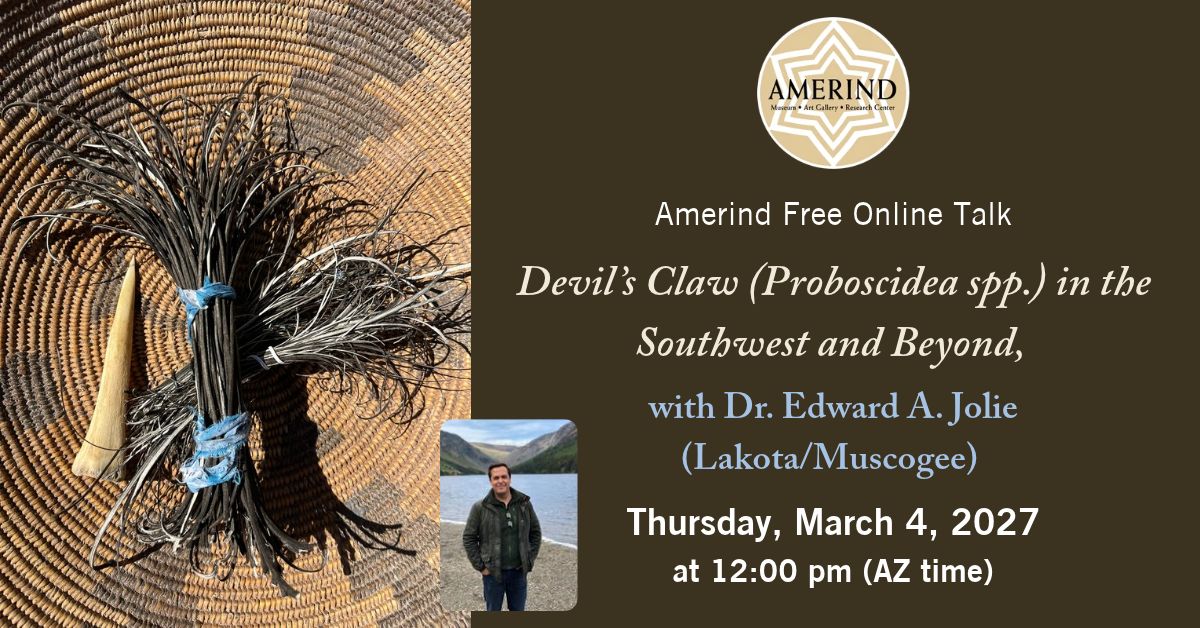
Amerind Free Online Talk
Thursday, March 4, 2027
12:00 pm (AZ time)
To register, visit: https://bit.ly/Amerindonline03042027Jolie
Join us on Thursday, March 4, 2027 at 12:00 pm (AZ time) for an online talk Devil’s Claw (Proboscidea spp.) in the Southwest and Beyond, with Dr. Ed Jolie.
Often referred to as the devil’s claw or unicorn plant (family Martyniaceae, genus Proboscidea), the appearance of its seed pods with two jet-black curved beak-like extensions or “claws” that terminate in sharp hooks is eye-catching. These common names might be taken to imply cruelty, difficulty, and mischievousness, or something mythical and mysterious. However, the plant’s seemingly enigmatic character is arguably due to a lack of wider awareness about the plant’s venerable relationship with Indigenous peoples and some enduring gaps in scientific knowledge. Native to the Americas, the genus Proboscidea includes six species, most of which are annual and well-adapted to arid environments. More than thirty Indigenous groups have used (and still use) devil’s claw, primarily the fiber from the claws for basketry, but also its seeds and immature fruits for food and medicine. Drawing on recent archaeological and botanical research, this presentation invites you to open your heart to devil’s claw by considering questions about the plant that you were (maybe) afraid to ask.
Dr. Edward A. Jolie (Lakota/Muscogee) is the Clara Lee Tanner Associate Curator of Ethnology at the Arizona State Museum and an Associate Professor of Anthropology in the School of Anthropology at the University of Arizona. Ed is an anthropologist interested in the Indigenous archaeology and ethnology of the Americas. His research focuses on the study of organic material culture such as textiles, basketry, and related crafts to address a wide range of anthropological questions. His applied scholarship focuses on hands-on work with fiber plant collection, processing, and weaving as part of an effort to find solutions to problems posed by landscape change and raw material inaccessibility among contemporary Indigenous communities.
We hope you will join us!