Amerind Free Online Talk
Thursday, May 28, 2026
12:00 pm (AZ time)
To register, visit: https://bit.ly/Amerindonline05282026Kintigh
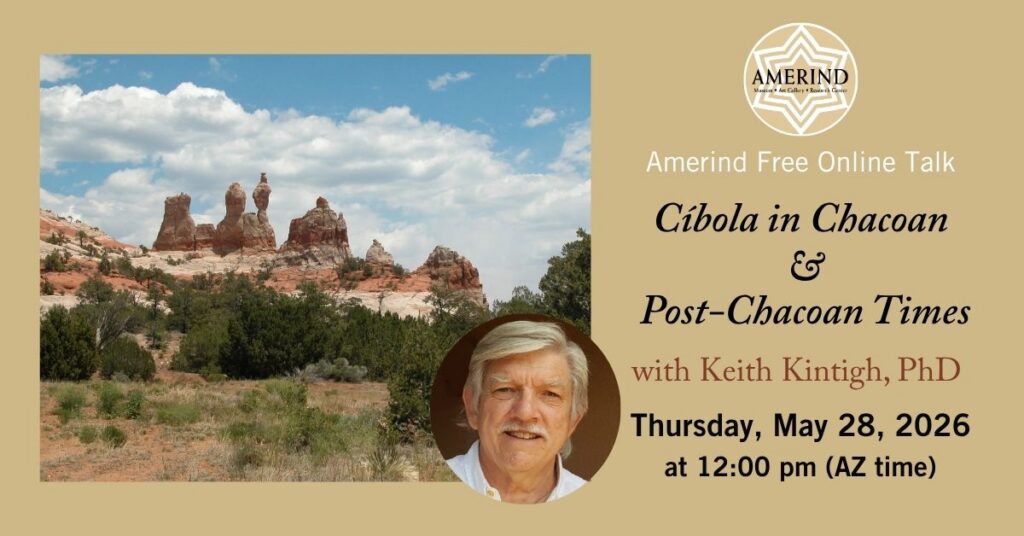
Please join us on Thursday, May 28, 2026 at 12:00 pm (AZ time) for a free online talk “Cíbola in Chacoan & Post-Chacoan Times” with Keith Kintigh, PhD.
Since 1896, the ruins in Chaco Canyon have been a focus of Southwest archaeologists’ attention. However, the recognition of Chaco as a regional system with outliers and roads only began about 50 years ago. Drawing on our limited excavations and extensive surveys over the last 45 years, I will discuss both the nature of the Chaco world and the regional consequences of Chaco’s collapse in the Cíbola area. I’ll start with a discussion of the H-Spear site, a Chaco outlier we located south of the Zuni Indian Reservation. While one might expect a nearby residential community, we found no contemporaneous occupation within .5 km of the great house; within 2km we located only 4 possibly contemporaneous room blocks with fewer than 20 rooms total. In contrast, 2.6km northwest of H-Spear, the post-Chacoan Hinkson Site has 32 residential room blocks with 525 rooms immediately surrounding a great house complex that includes an unroofed, oversize great kiva, a nazha, and roads. Using our excavations at and surveys around those two sites and the post-Chacoan great house site of Los Gigantes in the El Morro Valley, I’ll look at applying John Stein’s important idea of ritual landscapes, and the problematic concept of “community” over a period from AD1000-1275.
Keith Kintigh is Professor Emeritus of archaeology at Arizona State University. His field research focused on the organization of ancestral Pueblo societies in the Cíbola area. Throughout his career, Kintigh published on quantitative methods and developed computer programs to address unusual analytical needs of archaeologists. To enhance preservation and access to the digital records of archaeological investigations, Kintigh led a team of archaeologists and computer scientists in creating tDAR (the Digital Archaeological Record), a sustainable repository for the digital records of archaeological investigations. Over the last 10 years, Kintigh led a different team of archaeologists and computer scientist to develop SKOPE a web application that provides free, high resolution paleoclimatic data. In 2017 Jeffrey Altschul and Kintigh led the establishment of the Coalition for Archaeological Synthesis (CfAS) to promote synthetic research in archaeology. Kintigh continues to serve on the board of tDAR, has an active NSF grant for SKOPE, and serves, with Altschul, as co-president of CfAS. Kintigh is a past president of the Society for American Archaeology and, for SAA, has worked extensively on national law and policy regarding the repatriation of Native American human remains. Kintigh earned a BA in Sociology and an MS in Computer Science at Stanford University in 1974 and a PhD in Anthropology at the University of Michigan in 1982. He received ASU’s award for Outstanding Doctoral Mentor for 2004. He was a Fulbright Fellow in Ireland in 2011.
We hope you will join us!