Amerind will be at the Tucson Festival of Books

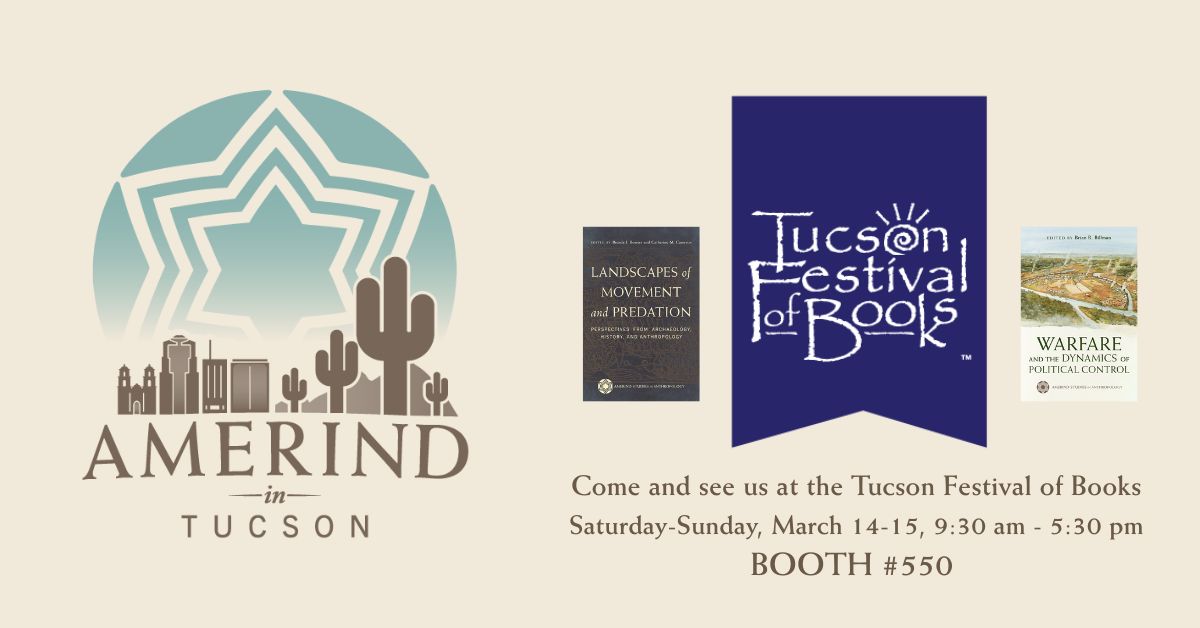
Amerind will be at the Tucson Festival of Books
Booth #550
Saturday & Sunday, March 14-15
9:30 am – 5:30 pm
Free Event
Where: University of Arizona Mall, Tucson, AZ

Join us for a weekend of books and more at the Tucson Festival of Books, where you can come out to see all the exhibitors, stop by the Amerind Booth #550 to say hello and pick up a free pass, learn about what’s new and happening at the Museum, and check out the Amerind Studies in Anthropology publications authored by our visiting scholars and researchers.

Check out the schedule to go to one or more of the many visiting author talks, all free, visit: tucsonfestivalofbooks.org for more information.

We hope to see you at the Book Festival!


Free Public Talk “Can Tomorrow’s AI Help Us Protect the Past?” with Dr. Jonathan Paige

Free Public Talk Saturday, March 7, 1-2 PM, Tucson
Can Tomorrow’s AI Help Us Protect the Past?
with Dr. Jonathan Paige
Presentation will be at the Tucson Museum of Art, 140 North Main Avenue
in the Alice Chaiten Baker Education Center

Archaeological sites are an irreplaceable part of our human heritage. How can we best protect them? How can we best find them? How can we learn from them?

The archaeological record represents over three million years of human behavior. However, it is challenging for us to integrate data and information from projects carried out by generations of researchers. The challenge of integrating data needs to be overcome if we are to synthesize information about the record, answer big questions about the human past, and protect the archaeological record itself.

Dr. Paige and a team of global researchers with the Coalition for Archaeological Synthesis are examining ways that Artificial Intelligence can help the archaeologists of tomorrow. Paige discusses the results of their group’s work, focusing on current approaches in using AI to protect and study the archaeological record, and their vision for how AI may be used in the future.

About the Speaker

Dr. Jonathan Paige is a Co-Director and Research Scientist with the Cultural Resource Sciences program, Center for Applied Fire and Ecosystem Science, New Mexico Consortium. He studies the evolution of technologies, the role they play in human evolution, and how groups adapt to new and challenging environments. He also works with federal agencies on advancing their capacity to perform comparative research through machine learning, developing models to identify archaeological sites on remote sensing imagery.

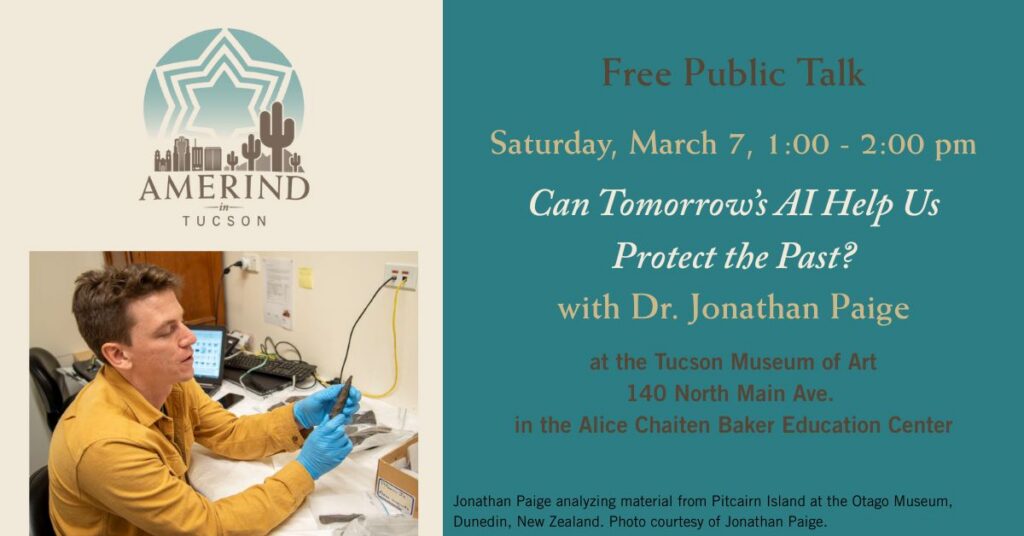
Photo Caption: Jonathan Paige analyzing material from Pitcairn Island at the Otago Museum, Dunedin, New Zealand. Photo courtesy of Jonathan Paige.

We hope you will join Amerind in Tucson!

Free Online Talk: “Life on the Edge of the Mimbres Region: Powers Ranch as a Mimbres Site” with Patricia Gilman & Mary Whisenhunt

Free Online Talk
Thursday, March 12, 2026
12:00 pm – 1:00 pm (AZ time)
Life on the Edge of the Mimbres Region: Powers Ranch as a Mimbres Site” with Patricia Gilman, PhD & Mary Whisenhunt, PhD

To register, visit: https://bit.ly/Amerindonline03122026Gilman

Join us on Thursday, March 12, 2026 at 12:00 pm (AZ time) for an online talk, “Life on the Edge of the Mimbres Region: Powers Ranch as a Mimbres Site”, with Patricia Gilman, PhD and Mary Whisenhunt, PhD.

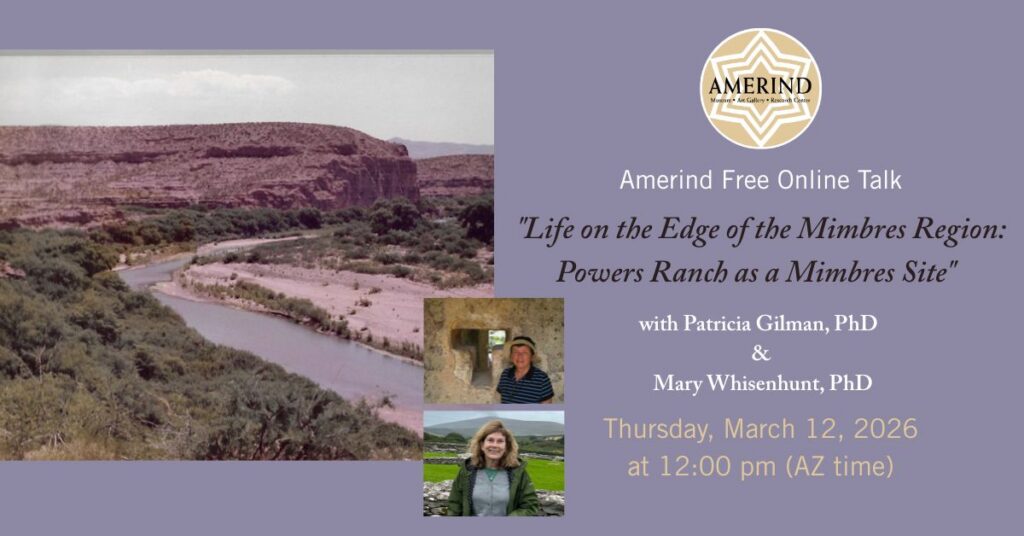
When people think of Mimbres archaeology, they picture beautiful black-on-white pottery with paintings of people and animals and large pueblo sites in the Mimbres Valley of southwestern New Mexico.  However, there were Mimbres sites beyond the Mimbres Valley, but they were different from those in the valley.  We explore what it meant to be Mimbres at the Powers Ranch site, a small settlement at the western edge of the Mimbres region. We conclude that the people at Powers Ranch were quintessentially Mimbres and were more closely affiliated with Mimbres settlements on the Gila River drainage in southeast Arizona and New Mexico than with those living in the Mimbres Valley core area.

Mary Whisenhunt received her anthropology doctorate in 2020, conducting her field work in southeast Arizona. Her research focused on the social resilience of precontact Indigenous people on the western boundary of the Mimbres region.

Patricia Gilman has done archaeological research in the Mimbres region for more than 50 years, retiring from the Department of Anthropology at the University of Oklahoma. One of her research foci has been Mimbres beyond the Mimbres Valley.

We hope you will join us!

If you can’t join us to watch live on March 12th, register using an email and the recorded talk will be sent to you after the talk, to watch at your leisure.


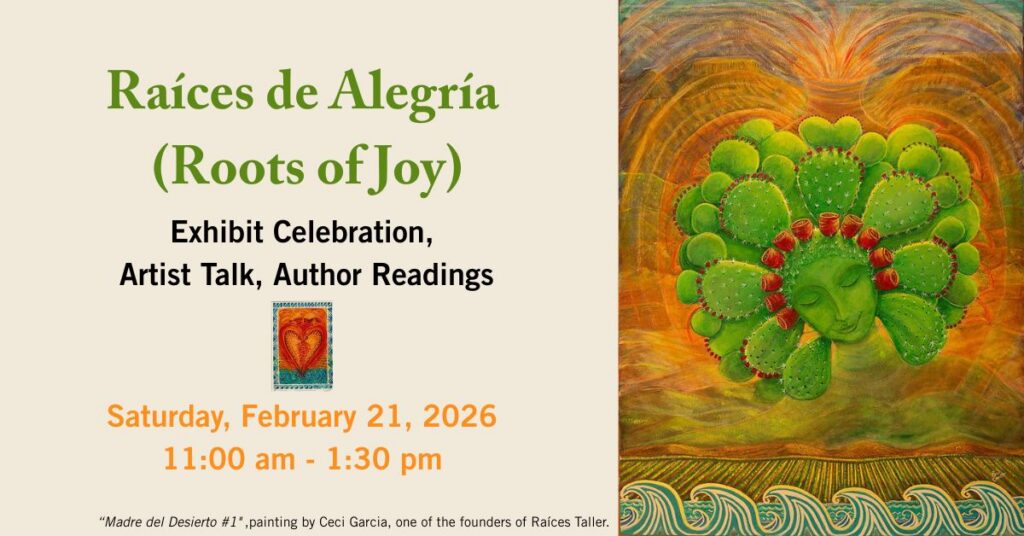
Raices de Alegria (Roots of Joy) Exhibit Celebration and Artist Talk


Raices de Alegria (Roots of Joy)
Exhibit Celebration, Artist Talk & Author Readings
Saturday, February 21, 2026
11:00 am – 1:30 pm 
Free event
From 11:00 am -12:00 pm we will host a Q&A artist panel talk with multiple artists from Raíces Taller.
12:00- 12:30 enjoy the exhibit and light refreshments
12:30 – 1:30 Mujeres que Escriben, a group of creative writers who will give readings of their work, creating a dialogue with the exhibition Join us as we celebrate this exhibit Raíces de Alegría (Roots of Joy) which features artwork by artists with the organization Raíces Taller 222 Art Gallery & Workshop. Eighteen artists from the Raíces Taller collective contributed to this juried show. Artists were asked to submit works inspired by joy, striving to share the roots of their joy with our visitors. Raíces Taller 222 Art Gallery & Workshop is a nonprofit arts organization headquartered in Tucson. For some thirty years, their organization has brought together very diverse people from our community to help create a better understanding of our community’s cultures and customs. Learn more about the Raíces Taller 222 Art Gallery & Workshop at www.raicestaller222.com.This exhibit runs through December 13, 2026.This Free event will waive Amerind’s regular Museum admission fees

For those wishing to hike in the Nature Preserve, Amerind’s regular hiking trail system admission fees will apply.

Free Online Talk “Our Elder Brother Dwells There: How I’itoi Ki Moved from Mountain Peak to Basket Design.” with David Martinez, PhD.

Photo: Early 20th Century O’odham Basket with “Man in the Maze” design, 13 1/4″ dia., Amerind permanent collection

Amerind Free Online Talk

Thursday, February 12, 2026

12:00 pm (AZ time)

Our Elder Brother Dwells There: How I’itoi Ki Moved from Mountain Peak to Basket Design.” with David Martinez, PhD. (Akimel O’odham/Hia-Ced O’odham/Mexican)

To register, visit: https://bit.ly/Amerindonline02122026Martinez

Join us on Thursday, February 12, 2026 at 12:00 pm (AZ time) for a free online talk, “Our Elder Brother Dwells There: How I’itoi Ki Moved from Mountain Peak to Basket Design.” with Dr. David Martinez.

“Learn about I’itoi, Elder Brother, who taught O’odham how to live well in their desert homelands. Learn where his home, his kih, is located, according to oral tradition. Most importantly, learn about how the symbol of this home, I’itoi kih, started appearing in O’odham baskets more than a century ago. What does it all mean?”

David Martínez (Akimel O’odham/Hia-ced O’odham/Mexican), Is a Professor of American Indian Studies and Transborder Studies at Arizona State University. He is the author of the forthcoming The Maze of History: Komal Hok, O’odham Teachings, and an Earth-Based Sense of Time (University of New Mexico Press, April 2026).

Martínez is also the author of Dakota Philosopher: Charles Eastman and American Indian Thought (Minnesota Historical Society Press, 2009), Life of the Indigenous Mind: Vine Deloria Jr and the Birth of the Red Power Movement (University of Nebraska Press, 2019), My Heart Is Bound Up With Them: How Carlos Montezuma Became the Voice of a Generation (University of Arizona Press, 2023), and editor of The American Indian Intellectual Tradition: An Anthology of Writings from 1772 to 1972 (Cornell University Press, 2011).

Dr. Martínez is also the director and founder of the Institute for Transborder Indigenous Nations (ITIN), which is housed in the School of Transborder Studies at ASU, where it focuses on Indigenous nations impacted by the US-Mexico Border.

Interested but unsure if you will be able to join us live? Register using an email and the recording of the talk will be sent later that evening to all registrants.

We hope you will join us for this fascinating talk.